Plastic Card Printer Price Range Guide: All Budgets Covered
Table of Contents []
- Your Complete Plastic Card Printer Price Range Guide from Plastic Card ID
- Understanding What Actually Drives Plastic Card Printer Pricing
- Entry-Level Plastic Card Printers: What $300-$700 Gets You
- Mid-Range Card Printers: The $700-$1,500 Sweet Spot
- Professional and Security-Grade Printers: $1,500-$3,500
- Premium and Industrial Card Printers: $3,500 and Above
- Accessories, Consumables, and the Full System Price
- Buying Smart: Tips from Plastic Card ID After 25 Years in the Field
Your Complete Plastic Card Printer Price Range Guide from Plastic Card ID
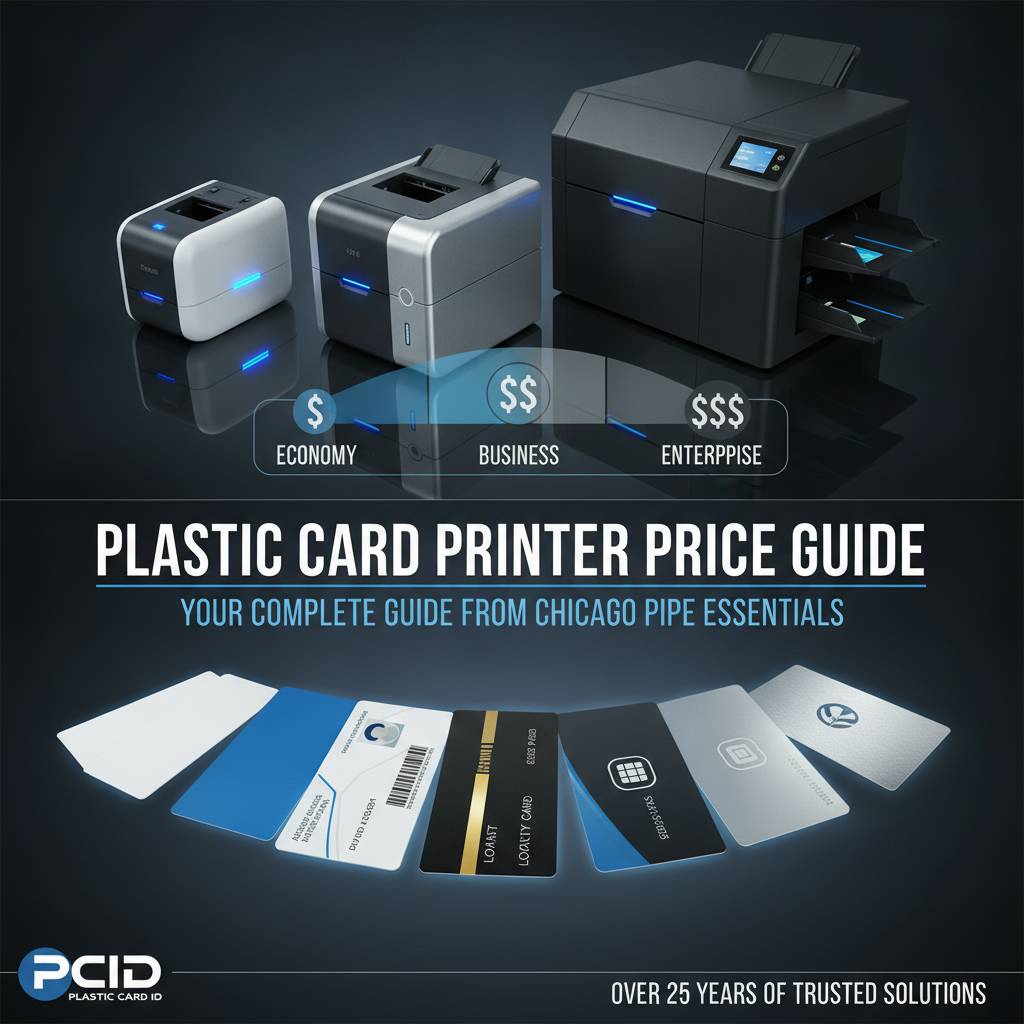 Buying a plastic card printer isn't like picking up office supplies. The decision involves understanding production volumes, card types, encoding needs, and long-term consumable costs - and getting it wrong means either overspending on features you'll never use or under-buying a machine that bottlenecks your entire card program. That's where a clear, honest price range guide becomes genuinely valuable.
Plastic Card ID has spent over 25 years putting professional-grade card printers into the hands of businesses across the United States. With more than 100,000 customers served and a curated lineup from Evolis, Fargo, Zebra, and Matica, the team at CPE knows exactly where each machine fits - and more importantly, where it doesn't. This guide breaks down the full plastic card printer price spectrum so you can invest with confidence.
| Price Tier | Typical Models | Best For | Approx. Price Range |
|---|---|---|---|
| Entry-Level | Evolis Badgy200 | Under 1,000 cards/year | $300-$600 |
| Mid-Range | Evolis Zenius, Primacy2 | 1,000-6,000 cards/month | $700-$1,500 |
| Professional | Fargo HDP5000, Zebra ZC300 | Security ID, access control | $1,500-$3,500 |
| Premium/Industrial | Evolis Agilia, Matica Event Printer | High-volume, edge-to-edge output | $3,500-$10,000 |
Understanding What Actually Drives Plastic Card Printer Pricing
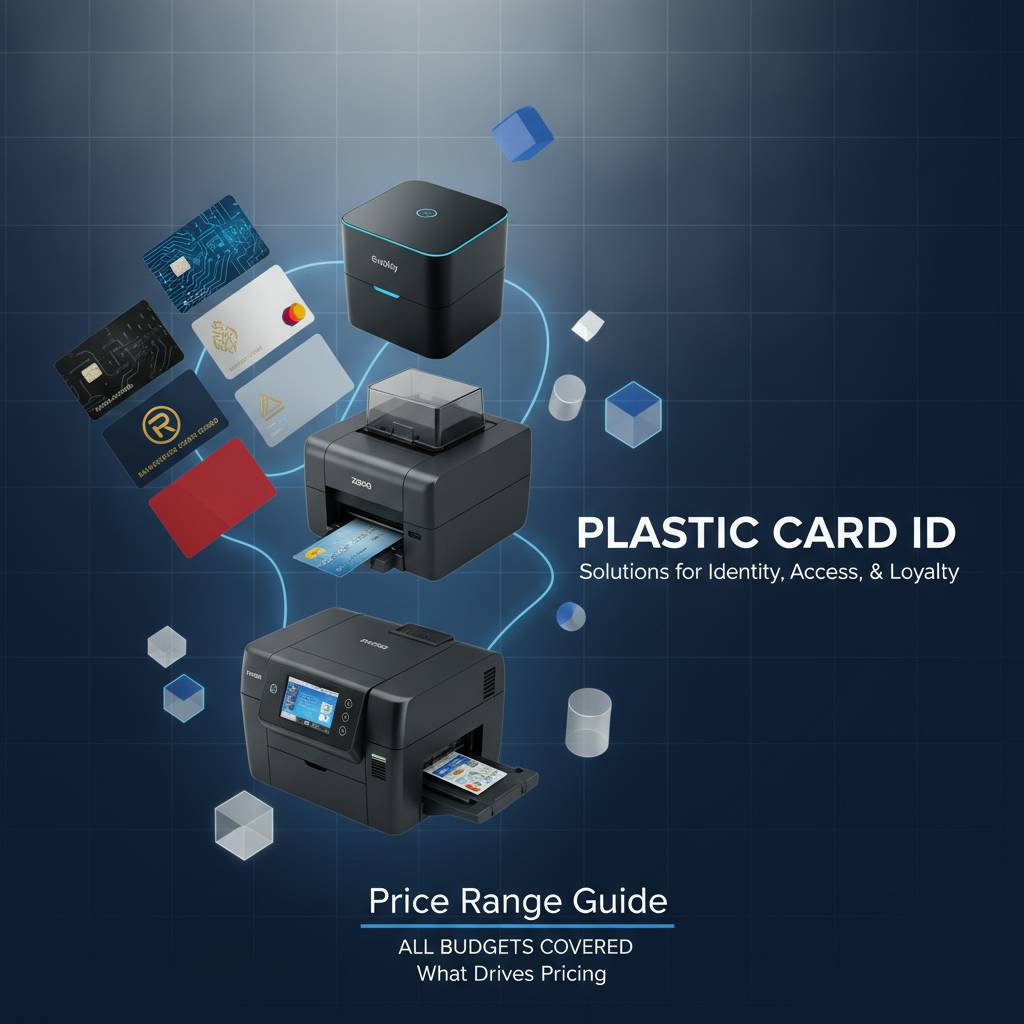 The sticker price on a card printer is really just the beginning of the conversation. Print technology, encoding capabilities, throughput speed, and build quality all feed into what you're actually paying for. A $400 printer and a $4,000 printer can both produce a plastic card - but the similarity often ends right there.
Most card printers use dye-sublimation technology, where a ribbon transfers color panels onto the card surface using heat. Entry-level machines use the same fundamental process as industrial units, but differ dramatically in ribbon capacity, print head durability, card handling precision, and encoding hardware. Understanding these variables is what separates a smart purchase from an expensive mistake.
Print Technology and Its Impact on Cost
Direct-to-card (DTC) printing is the most common and affordable technology. The print head sits close to the card surface and transfers dye directly - it's fast, reliable, and cost-effective. Most entry- and mid-range printers use this approach, and for the majority of business card programs, it's entirely sufficient.
High-definition printing (HDP), used in select Fargo models, prints to a film first and then transfers it to the card. This extra step adds cost but delivers sharper images, better edge-to-edge coverage, and enhanced durability. For security-critical ID programs or cards requiring fine facial photo detail, the price premium is often justified.
Single-Sided vs. Dual-Sided Printing
Dual-sided printing capability typically adds $200-$500 to the base price of any printer model. If your cards need content - logos, barcodes, cardholder details, legal text - printed on both sides, this upgrade is non-negotiable. Organizations printing employee ID cards, student IDs, and membership cards almost always need dual-sided output.
Single-sided models work well for simpler applications: loyalty cards with a pre-printed back, access control cards where only the front carries variable data, or hotel key cards where one side is sufficient. Know your card design before committing to a configuration.
Encoding Options and Their Price Additions
Magnetic stripe encoding, smart chip contact encoding, and contactless (RFID/NFC) encoding are all available as factory-installed or field-upgrade modules across several models in the CPE lineup. Each adds cost - typically $150-$600 per module depending on the encoding type and printer model.
If your card program involves access control, loyalty point tracking, or employee time-and-attendance systems, encoding is not optional. Factor these costs into your total system price from day one rather than discovering them post-purchase.
Entry-Level Plastic Card Printers: What $300-$700 Gets You
There's a real market for affordable card printers, and the Evolis Badgy200 sits at the top of that value tier for good reason. It's not a toy - it's a genuine professional tool for organizations with modest, predictable card volume. Schools printing student ID supplements, small businesses issuing loyalty cards, or clubs managing membership credentials will find this price range perfectly adequate.
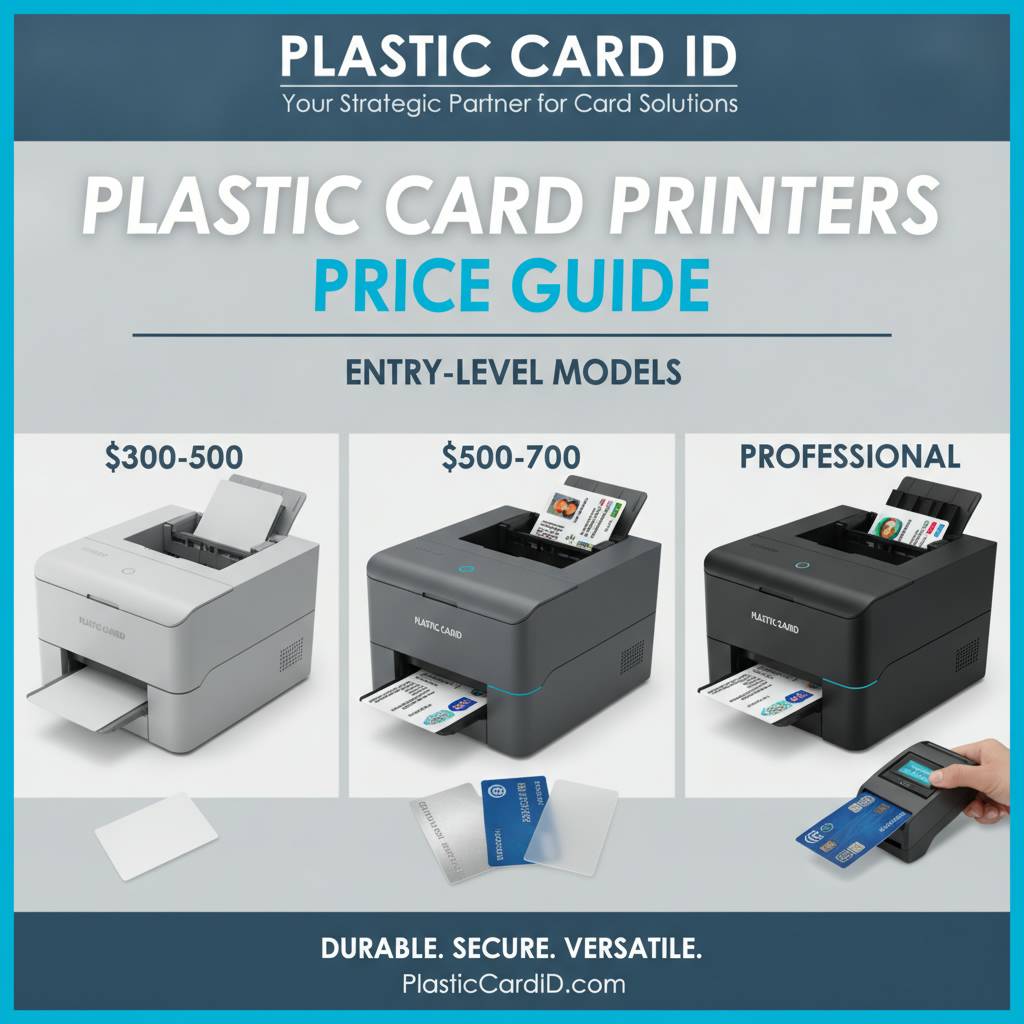
At $300-$600, you're getting a compact desktop unit, single-sided DTC printing, USB connectivity, and enough ribbon capacity to handle occasional card runs. What you're not getting: high-speed throughput, built-in encoding, or industrial-grade card handling. For under 1,000 cards per year, that trade-off is entirely reasonable.
The Evolis Badgy200 in Detail
The Badgy200 is purpose-built for low-volume environments. It ships with bundled software, an entry-level ribbon, and blank PVC cards - a true out-of-the-box setup. Print speed hovers around 100 cards per hour for color printing, which is more than adequate when you're printing batches of 20-50 cards at a time.
One feature that surprises buyers is the Badgy200's ribbon efficiency. The bundled YMCKO ribbon produces clean, vivid color output with a protective overlay panel, extending card life significantly. For small organizations that need professional-looking results without a large upfront investment, this machine consistently delivers.
Consumable Costs at the Entry Level
Ribbon costs for entry-level printers typically run $0.25-$0.60 per card for full-color YMCKO output. At low annual volumes, this is negligible. But if your volume unexpectedly grows, those per-card costs compound quickly - which is one reason mid-range printers with larger ribbon capacities become more economical at higher volumes.
Cleaning kits are another recurring cost, usually $15-$30 per kit. CPE recommends cleaning printer internals every 1,000 cards printed, or whenever a new ribbon is installed. Skipping this maintenance step is the single most common cause of premature print head failure - an expensive lesson to learn on any printer, regardless of price tier.
Who Should Buy at This Price Point
Entry-level card printers make sense for nonprofits, small membership organizations, boutique hotels, and businesses just beginning an in-house card program. If your card program is exploratory - you're not sure of the long-term volume or use case - starting here is perfectly defensible.
However, if you already know you'll need magnetic stripe encoding, dual-sided printing, or more than 1,000 cards annually, skip this tier. You'll spend more upgrading later than you would have investing in the right mid-range machine upfront. Contact Plastic Card ID at 800.835.7919 if you're unsure which tier fits your actual requirements.
Mid-Range Card Printers: The $700-$1,500 Sweet Spot
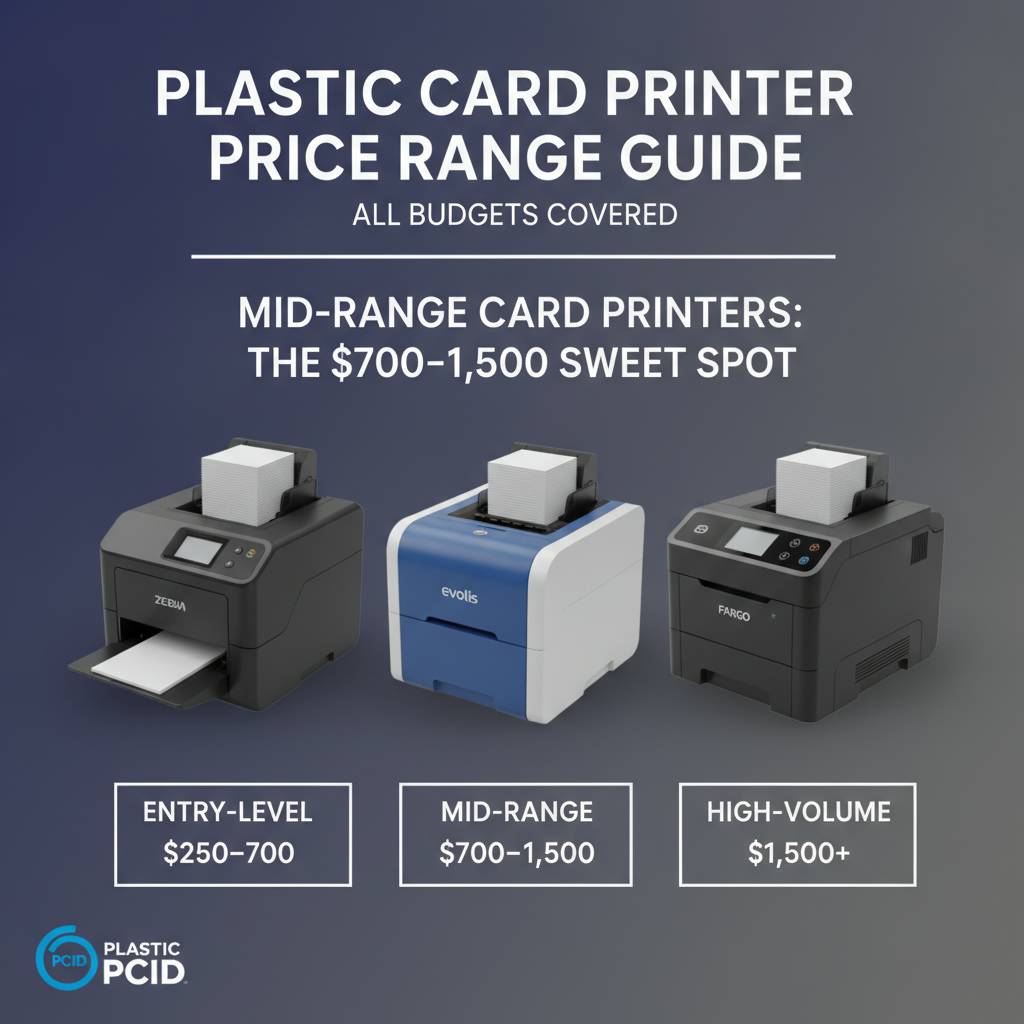 This is where the majority of serious card programs live. The Evolis Zenius and Evolis Primacy2 occupy this tier, and for good reason - they strike the balance between affordable upfront cost and professional-grade daily performance. Organizations printing 1,000 to 6,000 cards per month find this range handles their needs without unnecessary overhead.
The Primacy2 is a particular standout in this category. It supports dual-sided printing, magnetic stripe encoding, and lamination modules - all configurable at purchase or upgradeable in the field. Its print speed and ribbon capacity are meaningfully better than entry-level units, and its build quality reflects a machine designed for sustained daily use rather than occasional batch runs.
Evolis Zenius: Simple, Reliable, and Scalable
The Zenius is often described as a workhorse by the organizations that rely on it. Single-sided by default, it handles color YMCKO printing at competitive speeds and accepts encoding module upgrades. It's a popular choice for HR departments issuing employee ID cards, mid-size schools managing student credentials, and libraries running patron card programs.
Its software integration is smooth - compatible with popular ID card design applications and capable of pulling data from HR databases or spreadsheets. For organizations that need a reliable printer without complexity, the Zenius hits the mark consistently.
Evolis Primacy2: Dual-Sided Performance at a Mid-Range Price
When your card design requires information on both sides - and most professional ID cards do - the Primacy2's dual-sided capability becomes essential. The flipper module handles card reversal internally, so there's no manual intervention required mid-batch. That matters when you're printing 200 cards for a corporate event or issuing a semester's worth of student IDs.
Lamination module compatibility is another Primacy2 advantage. Adding a laminate overlay to each card dramatically improves durability and creates a premium feel - relevant for membership cards, loyalty cards, and credentials meant to represent a brand's quality. Lamination hardware in this price range is a genuine value proposition.
Calculating True Cost of Ownership in the Mid-Range
Smart buyers look beyond the printer's purchase price. Mid-range YMCKO ribbons typically cost $0.18-$0.40 per card at higher panel counts, cleaning kits add a modest ongoing cost, and lamination film adds another $0.10-$0.25 per card if used. At 3,000 cards per month, these numbers deserve attention.
The good news: mid-range printers often have lower per-card consumable costs than entry-level models due to larger ribbon capacity and better material efficiency. Over 12-18 months, the total cost of ownership on a Primacy2 frequently beats a Badgy200 for organizations at moderate volumes. CPE can run these calculations with you before purchase.
| Printer | Sides | Encoding Options | Approx. Cards/Hour | Price Range |
|---|---|---|---|---|
| Evolis Badgy200 | Single | None standard | 100 | $300-$600 |
| Evolis Zenius | Single | Mag stripe optional | 150 | $700-$1,000 |
| Evolis Primacy2 | Dual optional | Mag stripe, smart chip | 200 | $950-$1,500 |
| Fargo / Zebra Pro | Dual | Full encoding suite | 250 | $1,500-$3,500 |
Professional and Security-Grade Printers: $1,500-$3,500
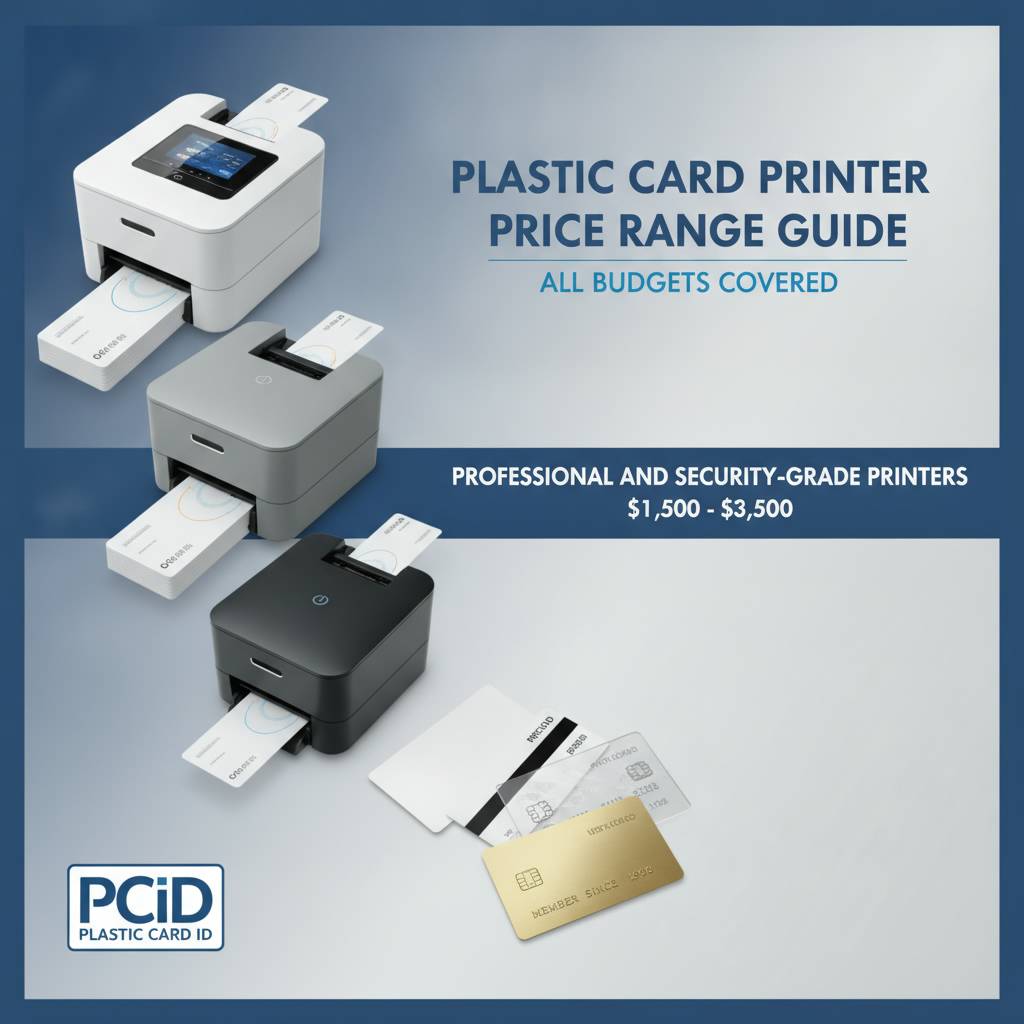 Fargo and Zebra printers dominate this tier for a reason. Government agencies, large healthcare networks, universities, and corporations with security-sensitive ID programs gravitate toward these machines because the stakes are higher. A card that grants building access or holds encrypted employee credentials needs to be produced on hardware built to demanding specifications.
This price range buys you faster throughput, more robust card handling mechanisms, enhanced encoding suites, and HDP printing options in select Fargo models. The Zebra ZC300 and ZC500 series bring strong reliability records and enterprise-level software compatibility to organizations that need scalable, manageable card issuance infrastructure.
Fargo Printers: Security-First Design
Fargo's lineup emphasizes security at every level. HDP printing ensures card imagery is crisp and tamper-evident, while optional holographic overlay ribbons and secure lamination add physical security features that make counterfeiting significantly more difficult. For government IDs, healthcare credentials, and corporate access control, these aren't luxuries - they're requirements.
Fargo's software ecosystem also deserves mention. Integration with major access control platforms and identity management systems means the printer fits neatly into existing security infrastructure rather than requiring workarounds. For IT and security teams, that compatibility has real operational value.
Zebra ZC Series: Enterprise Reliability
Zebra brings its enterprise hardware reputation to card printing with the ZC series. These printers are built for sustained high-volume use, with large ribbon capacities, intuitive touchscreen interfaces, and network connectivity that supports centralized print management across multiple locations. Organizations with distributed card issuance needs - multiple campuses, multiple facilities - find Zebra's network management tools genuinely useful.
Magnetic stripe, smart card, and contactless encoding modules are all available for ZC series units. For loyalty programs, employee ID systems, and student card programs requiring encoded functionality, the ZC lineup handles the full spectrum without compromise.
When to Invest at This Tier
The $1,500-$3,500 range is the right choice when card security matters, when daily volume demands fast throughput, or when encoding complexity requires hardware precision. If you're issuing access control cards for a 500-person facility, running a university student ID program, or managing a corporate badge program with photo ID requirements - this tier is your baseline, not an upgrade.
Buyers who stretch into this range from the mid-tier often report wishing they'd done it sooner. The per-card consistency, the speed, and the encoding reliability translate directly into reduced reprints, fewer support calls, and a card program that simply works. Reach out to Plastic Card ID at 800.835.7919 to discuss which professional-grade model fits your specific security and volume requirements.
Premium and Industrial Card Printers: $3,500 and Above
At the top of the price spectrum, card printing becomes a production operation. The Evolis Agilia and Matica Event Printer represent what's possible when volume, quality, and speed are all non-negotiable simultaneously. These machines are not for every organization - but for the ones that need them, nothing else will do.
The Evolis Agilia delivers edge-to-edge full-color printing with exceptional image quality, handling demanding card programs that require premium visual output. The Matica Event Printer is built for a very specific but high-demand scenario: on-site badge printing at large events, conferences, and venues where hundreds or thousands of credentials need to be issued quickly and accurately.
Evolis Agilia: Premium Output at Scale
Edge-to-edge printing without white borders is the Agilia's defining capability. For cards where the full surface needs to carry graphics - branded membership cards, premium loyalty credentials, event VIP passes - the visual difference compared to standard DTC output is immediately apparent. This is a machine for organizations where card appearance directly represents brand quality.
The Agilia also supports a full suite of encoding options and lamination, making it as functionally capable as it is visually impressive. High-volume organizations that want both security features and premium aesthetics find the Agilia uniquely positioned in the market.
Matica Event Printer: Speed for High-Stakes Moments
Conference registration. Stadium access. Trade show credentialing. These scenarios share one brutal constraint: you need a lot of cards, right now, with zero tolerance for jams or print failures. The Matica Event Printer is engineered specifically for these moments - high throughput, reliable card handling, and rapid output that keeps lines moving and attendees happy.
Organizations running large annual events often find that owning a Matica Event Printer pays for itself quickly compared to outsourced credential printing, which carries lead times, shipping risks, and inflexibility when attendee lists change at the last minute. In-house issuance at this scale is a genuine operational advantage.
Industrial Printer Consumables and Support Costs
At this price tier, consumable costs per card often decrease relative to mid-range printers due to high-capacity ribbons and efficient material use. However, maintenance contracts, cleaning supplies, and lamination film represent meaningful ongoing expenses that buyers should budget for explicitly.
Input hoppers - which allow large card batches to be loaded without interruption - and card output stackers are common accessories at this tier, adding $200-$600 to the system cost but enabling truly unattended batch printing. CPE recommends discussing the full accessory ecosystem when specifying an industrial system.
Accessories, Consumables, and the Full System Price
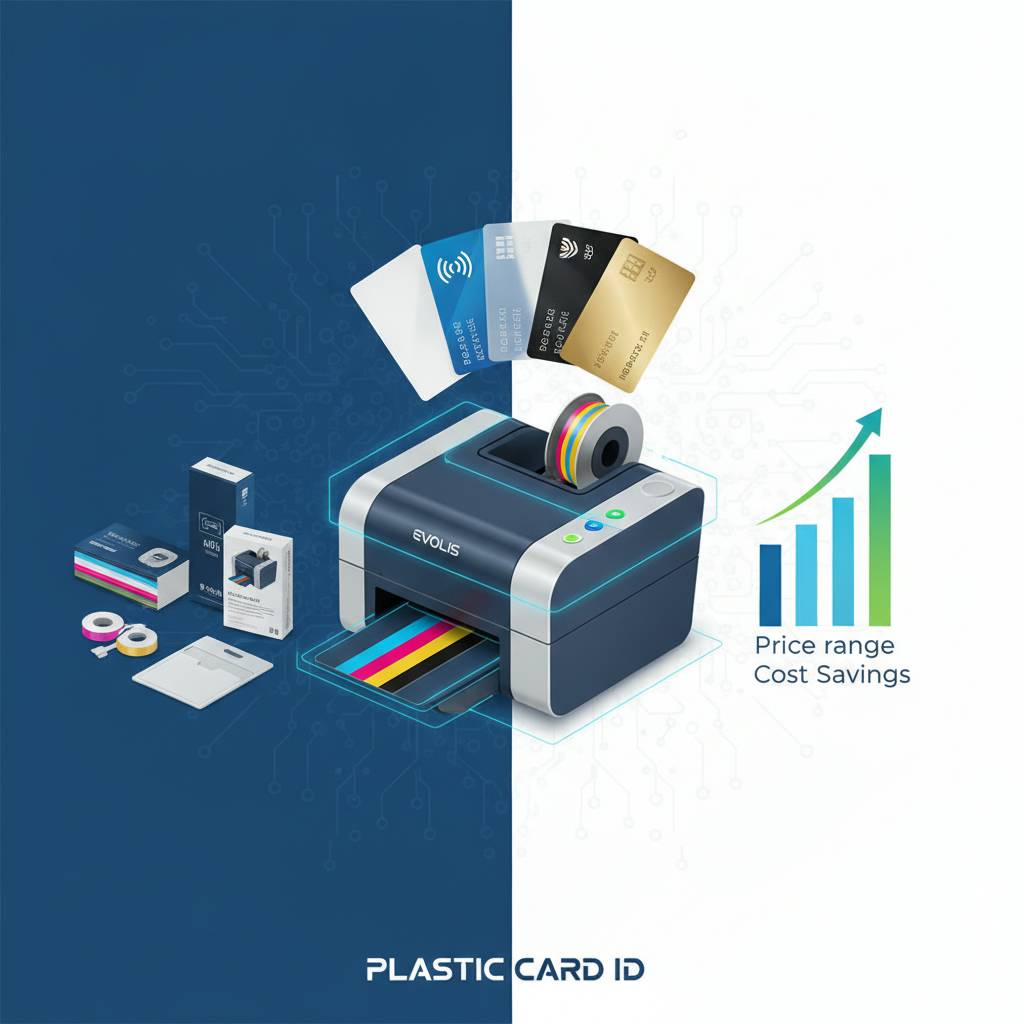 A card printer without ribbons, cleaning kits, and blank cards is an expensive paperweight. The real cost of a card printing program includes consumables and accessories, and overlooking them when budgeting is a common and avoidable mistake. Plastic Card ID supplies everything needed to keep any card program running at full output.
Ribbons are the most frequent consumable purchase. YMCKO full-color ribbons for color photo IDs, monochrome ribbons for single-color text-only cards, and specialty ribbons for holographic overlays all serve different needs at different price points. Choosing the right ribbon type for your card design directly affects per-card cost and output quality.
Ribbon Types and Costs
YMCKO ribbons (Yellow, Magenta, Cyan, Black, Overlay) are the standard for full-color ID card printing. Prices range from $30-$150 per ribbon depending on panel count and printer compatibility. Monochrome black ribbons for simple text-only applications run significantly cheaper, often $20-$50, with much higher card yields per ribbon.
- YMCKO ribbons: Full-color output with protective overlay - ideal for photo ID cards
- Monochrome ribbons: Single-color, high-yield - best for access cards, loyalty cards with minimal graphics
- YMCKOK ribbons: Dual black panels for sharper text on the overlay side
- Specialty/holographic ribbons: Security overlay options for tamper-evident credentials
- Cleaning kits: Essential for print head longevity - budget $15-$30 per kit, used every 1,000 cards
Lamination Modules and Their Value
Lamination modules, available for several mid-range and professional printers, apply a thin film over printed cards to enhance durability and add a premium tactile quality. The hardware cost varies by printer model - typically $500-$1,200 for the module - while lamination film adds $0.10-$0.30 per card in material cost. For cards that need to survive years of daily handling, lamination is worth every cent.
Beyond durability, lamination enables printed holographic overlays that serve as a visual security feature. For employee ID programs and student credentials where card forgery is a concern, this combination of protection and authentication is increasingly standard practice.
Card Carriers, Sleeves, and Supporting Hardware
Card carriers and sleeves protect finished credentials during distribution and daily use. These accessories run $20-$80 per pack depending on style and quantity, and they extend card life considerably. Lanyards, badge reels, and cardholder accessories round out the ecosystem - small costs individually, but worth accounting for in program budgets.
Input hoppers and output stackers, as mentioned for industrial printers, are also available for several mid-range models and allow for batch printing without manual card feeding. If your team regularly prints runs of 50-200 cards, these accessories convert a manual process into a genuinely automated one - freeing staff for other tasks while the printer works unattended.
Buying Smart: Tips from Plastic Card ID After 25 Years in the Field
 After serving more than 100,000 customers across every industry and card type imaginable, CPE has seen the full spectrum of buying decisions - the brilliant ones and the expensive ones. A few consistent lessons emerge that any buyer should internalize before committing to a card printing system.
The most important tip: buy for your expected volume in 18-24 months, not your volume today. Card programs almost always grow. An organization that issues 500 cards per year today may be at 2,000 in two years after expanding a loyalty program or scaling a security badge initiative. A printer purchased at the edge of its capacity will be replaced far sooner than one purchased with appropriate headroom.
Match the Machine to the Card Type
Different card applications have genuinely different requirements. Employee ID cards with photos need dual-sided printing and potentially encoding. Hotel key cards need mag stripe encoding but minimal color printing. Event badges need speed above all else. Loyalty cards need consistent color quality and high volume capacity. There is no single best printer - there is only the right printer for your specific program.
Before contacting any vendor, know your card design, your annual or monthly volume estimate, your encoding requirements, and your budget for both hardware and ongoing consumables. Armed with that information, the selection process becomes straightforward rather than overwhelming.
Don't Underestimate Consumable Budget Planning
A $1,000 printer paired with $2,000 in annual ribbon costs is a $3,000 first-year investment. A $2,500 printer with $1,200 in annual ribbon costs may be cheaper over two years. Total cost of ownership math is non-negotiable for any organization that takes its card program seriously. CPE can provide consumable cost estimates for any printer model based on your volume and card type.
- Estimate your monthly card volume honestly - round up, not down
- Identify whether you need single or dual-sided printing
- Confirm encoding requirements before finalizing printer selection
- Budget for at least 12 months of ribbons and cleaning kits upfront
- Ask about accessory compatibility before assuming a module is available
Leverage Expert Guidance Before You Buy
With 25 years of experience and a lineup spanning every major professional brand, Plastic Card ID isn't just a retailer - it's a genuine resource. The team at CPE has matched card printers to HR departments, universities, event companies, hotels, healthcare facilities, and hundreds of other organization types. That depth of experience translates into recommendations that fit, not just suggestions that sell.
Whether you're starting your first card program or upgrading an existing one that's outgrown its current hardware, a conversation before purchase pays for itself. Call 800.835.7919 and talk through your requirements with a team that's been doing this longer than most of the competition has existed.
Ready to find the right card printer at the right price? Plastic Card ID is standing by to help you navigate every tier of the market and build a card program that performs from day one through year ten. Call 800.835.7919 today.
Plastic Card Printer for Hotel Key Cards Fast & Reliable
Previous Page