Plastic Card Printer for Student ID Cards: Top Choices
Table of Contents []
- The Right Plastic Card Printer for Student ID Cards Starts Here - Plastic Card ID
- Matching Printer Volume to Your School's Actual Needs
- Printer Supplies That Keep the Program Running
- Brands in the Lineup and What Each Brings to the Table
- Frequently Asked Questions About Student ID Card Printers
- Buyer Tips Before You Choose a Student ID Card Printer
- Build a Student ID Card Program That Works - Plastic Card ID
The Right Plastic Card Printer for Student ID Cards Starts Here - Plastic Card ID
 Walk into almost any school, college, or university in the country and you'll find them: student ID cards tucked into lanyards, tapped against card readers, scanned at cafeteria checkout lanes. These cards do serious work. They verify identity, control building access, track meal plans, unlock library privileges, and serve as the daily face of an institution's brand. Yet somehow, the question of how those cards actually get printed doesn't always receive the attention it deserves.
That's where decisions get interesting. Outsourcing card production means lead times, minimum order quantities, and zero flexibility when a student enrolls mid-semester or loses their card on a Tuesday afternoon. Bringing printing in-house flips that equation entirely. With the right plastic card printer for student ID cards, a school can produce a professional, encoded, photo-quality ID in minutes - on demand, on site, on budget.
Plastic Card ID has been supplying plastic card printers and the full ecosystem of supplies around them to institutions across the United States for over 25 years, serving more than 100,000 customers along the way. The depth of product knowledge here is real, and the lineup has been carefully curated to match every production scale a school or district might face.
Why Student ID Cards Demand a Dedicated Printing Solution
Student populations shift constantly. New enrollments, transfers, replacements, staff additions - the demand for fresh cards doesn't pause neatly between semesters. An in-house plastic card printer for student ID cards eliminates the friction entirely. Need ten cards today? Print them. Need to encode a magnetic stripe for cafeteria access? Done at the desktop.
The alternative - sending card data to a third-party vendor, waiting days or weeks, paying per-card premiums, and then managing card distribution - creates friction at every step. Institutions that switch to in-house printing frequently describe the shift as transformative, not just operationally but in terms of data security as well.
What "In-House Control" Actually Means
Control isn't just a buzzword here. When a school prints its own student ID cards, the card design stays internal, student photos never leave the building, and encoding for magnetic stripe or smart chip access happens on the same machine that prints the card. That level of data sovereignty matters enormously to administrators and compliance officers alike.
Beyond security, on-demand printing means personalization at scale. Each card carries a student's actual photo, name, ID number, and any encoded data specific to their profile. No batch minimums. No generic placeholders waiting to be customized by a vendor who doesn't know your institution.
Who Plastic Card ID Serves in the Education Sector
From small private academies printing a few hundred cards per year to large public university systems running continuous card issuance operations, CPE has matched institutions to the right hardware. K-12 districts, community colleges, vocational schools, graduate programs, and student housing operations all have distinct volume requirements and feature needs - and the product lineup covers them all.
Contact Plastic Card ID at 800.835.7919 to speak directly with someone who understands educational card programs and can help identify the right printer model, ribbon type, and encoding configuration for your institution's specific workflow.
| Printer Model | Brand | Recommended Volume | Dual-Sided | Encoding Options |
|---|---|---|---|---|
| Badgy200 | Evolis | Under 1,000 cards/year | No | Basic |
| Zenius | Evolis | 1,000-3,000 cards/month | Optional | Mag Stripe, Smart Chip |
| Primacy2 | Evolis | Up to 6,000 cards/month | Yes | Mag Stripe, Smart Chip |
| Agilia | Evolis | High-volume, premium output | Yes | Full Encoding Suite |
| Fargo HDP Series | Fargo | Mid-to-high volume | Yes | Security Encoding |
| Zebra ZC Series | Zebra | Mid-volume, ID programs | Yes | Mag Stripe, Smart Chip |
Matching Printer Volume to Your School's Actual Needs
 Here's a mistake institutions make more often than you'd expect: buying hardware sized for a much larger - or much smaller - operation than the one they're actually running. Overspend on an industrial system for a school that prints 400 cards a year and you've wasted budget. Underinvest in a low-capacity desktop for a district processing thousands of new enrollments each fall and you'll face bottlenecks almost immediately.
Matching printer capacity to real-world demand is one of the most important decisions in building a student ID card program. Volume tiers are a practical guide, not just a spec sheet category. Understanding them upfront saves money, avoids frustration, and produces better long-term outcomes.
Entry-Level Printers for Smaller Schools and Programs
The Evolis Badgy200 is the textbook answer for small academies, daycare programs, or after-school organizations that print fewer than 1,000 cards annually. It's compact, straightforward, and produces full-color photo-quality cards that genuinely look professional. Setup is minimal, ribbon changes are simple, and the learning curve is virtually flat.
For these lower-volume environments, the per-card cost of an YMCKO ribbon is easily offset by eliminating vendor fees and turnaround delays. A replacement card for a student who lost theirs? Printed in under two minutes. That speed is something no outside vendor can match.
Mid-Range Workhorses for Growing Institutions
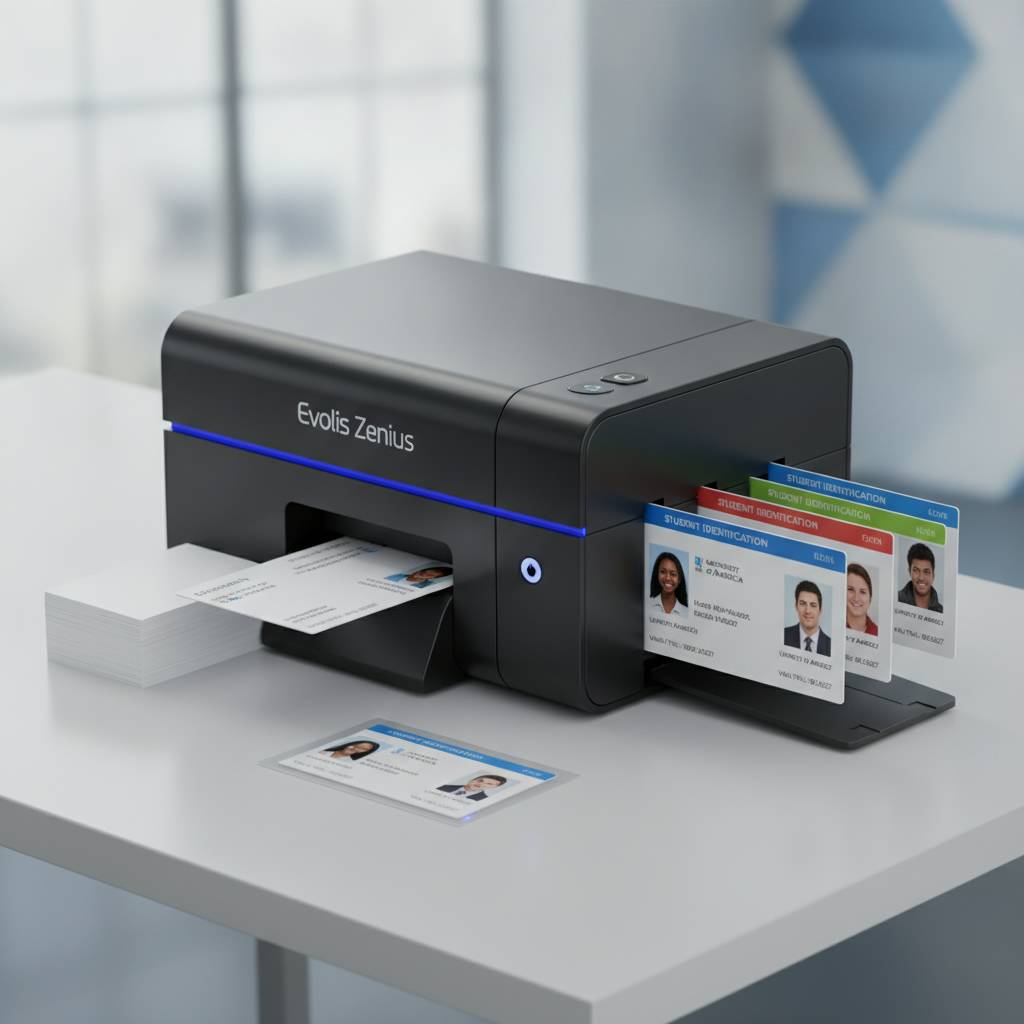
The Evolis Zenius and Primacy2 occupy the sweet spot for schools and colleges operating active, year-round card programs. The Zenius handles single-sided printing with optional encoding, while the Primacy2 steps it up with dual-sided output and the ability to print both card faces - student photo on front, barcode and policy text on back - in a single pass.
At volumes between 1,000 and 6,000 cards per month, these machines earn their place. They're fast, reliable, and the modular design means institutions can upgrade encoding capabilities without replacing the entire unit. That kind of scalable hardware investment is exactly what budget-conscious education administrators need to hear.
High-Output Printers for Large Universities and Districts
Large public universities, sprawling K-12 districts, and community college systems with multiple campuses face a different challenge altogether. Card issuance at this scale demands hardware with extended input hoppers, automated card handling, and the capacity to sustain consistent output quality through thousands of cards per print run.
The Evolis Agilia delivers edge-to-edge, premium-grade printing that holds up under high-volume demand without compromising on image quality or card consistency. For institutions where student ID cards also function as access control credentials, the precision and reliability of the Agilia make it a compelling choice. Call Plastic Card ID at 800.835.7919 to discuss high-volume configurations.
Event and On-Site Badge Printing Considerations
Some educational contexts call for rapid on-site credential production: orientation events, large enrollment days, athletic events, or campus-wide registration sessions. The Matica Event Printer is engineered for exactly these scenarios, producing cards at high speed in environments where throughput matters more than anything else.
Having an event printing solution alongside a primary student ID printer gives institutions flexibility across their entire calendar - not just during normal office hours but during the high-demand moments that tend to stress unprepared card programs most severely.
Printer Supplies That Keep the Program Running
A plastic card printer for student ID cards is only as effective as the supplies feeding it. Ribbon choice, cleaning schedules, and protective lamination all directly affect output quality and equipment longevity. Institutions that treat supplies as an afterthought tend to encounter print quality degradation, increased maintenance calls, and premature printhead wear - all of which are avoidable.
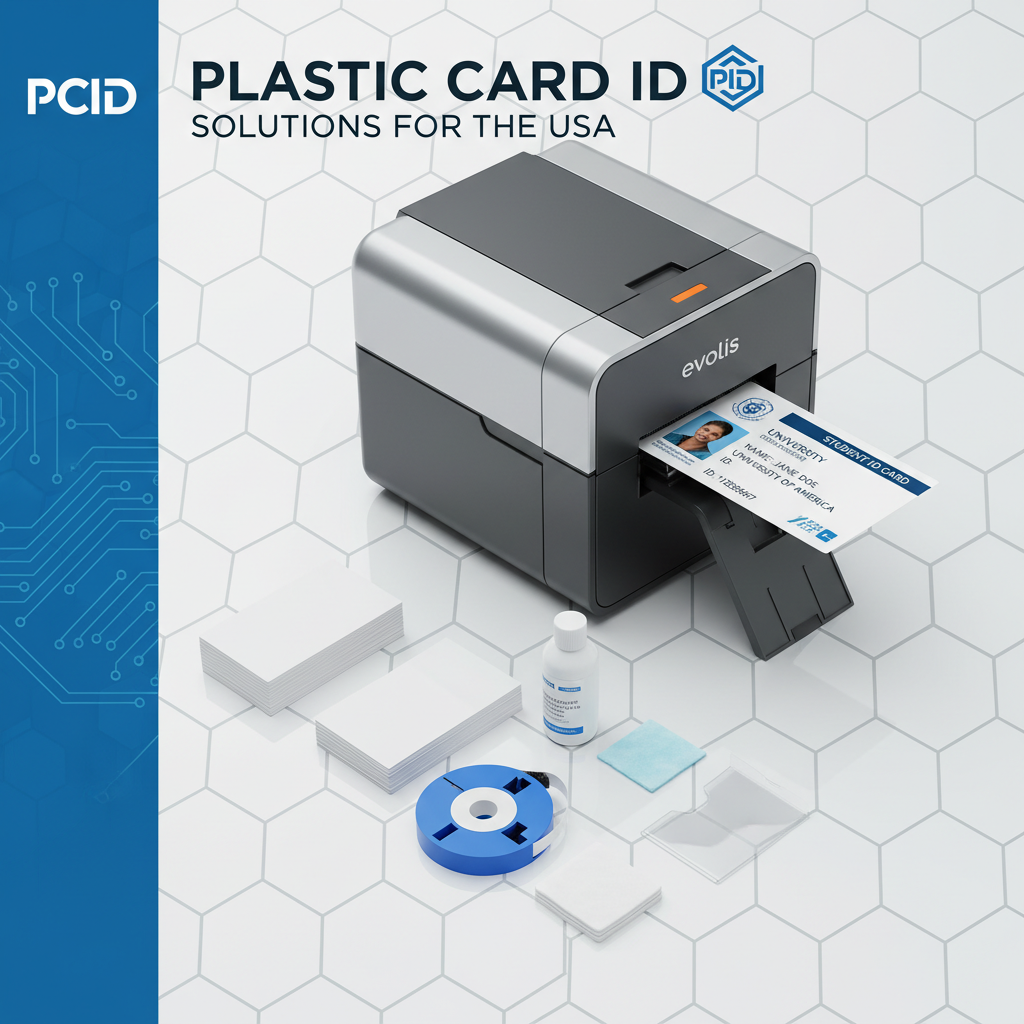
CPE stocks the full range of supplies needed to sustain a professional card program: YMCKO full-color ribbons, monochrome ribbons for single-color applications, specialty ribbons, cleaning kits, and lamination modules that add a durable protective layer to finished cards.
Ribbon Types and When to Use Each
YMCKO ribbons - yellow, magenta, cyan, black, and overlay - are the standard choice for full-color student ID cards with photo personalization. They produce vivid, accurate color reproduction and include a clear protective overlay that resists surface scratching and UV exposure. For the typical student ID card, YMCKO is the go-to ribbon type.
Monochrome ribbons print a single color - usually black - at significantly higher card yields per ribbon roll. For applications like temporary visitor passes, supplemental credentials, or batch printing where color isn't required, monochrome ribbons dramatically reduce per-card cost. Understanding ribbon economics matters when you're managing a program budget carefully.
Cleaning Kits and Printhead Longevity
Card printers are precision instruments. Dust, debris from card stock, and ribbon residue accumulate inside the print path and on the printhead surface over time. Without regular cleaning, image quality suffers first - then mechanical components begin to degrade. Most manufacturers recommend cleaning after every ribbon change at minimum.
Cleaning kits include roller cleaning cards, printhead cleaning swabs, and cleaning solution suited to the specific printer model. Following a regular maintenance schedule isn't just about quality - it directly extends the working life of a printer that represents a meaningful capital investment for any school or district.
Lamination, Encoding Upgrades, and Input Hoppers
Lamination modules attach to compatible printers and apply a thin protective film to both card faces after printing. For student ID cards that see daily use - being stuffed into pockets, scanned repeatedly, and generally treated without ceremony - lamination adds meaningful durability. Cards last longer, colors stay vivid, and the professional appearance is preserved through extended daily wear.
Encoding upgrades allow a base printer model to write data to magnetic stripes or smart chips embedded in the card stock. For student ID cards that also function as meal plan cards, access control credentials, or library checkout tools, encoding turns a photo ID into a fully functional institutional credential. Input hoppers extend the card feed capacity for batch printing sessions, reducing the need for manual intervention during large print runs.
Brands in the Lineup and What Each Brings to the Table
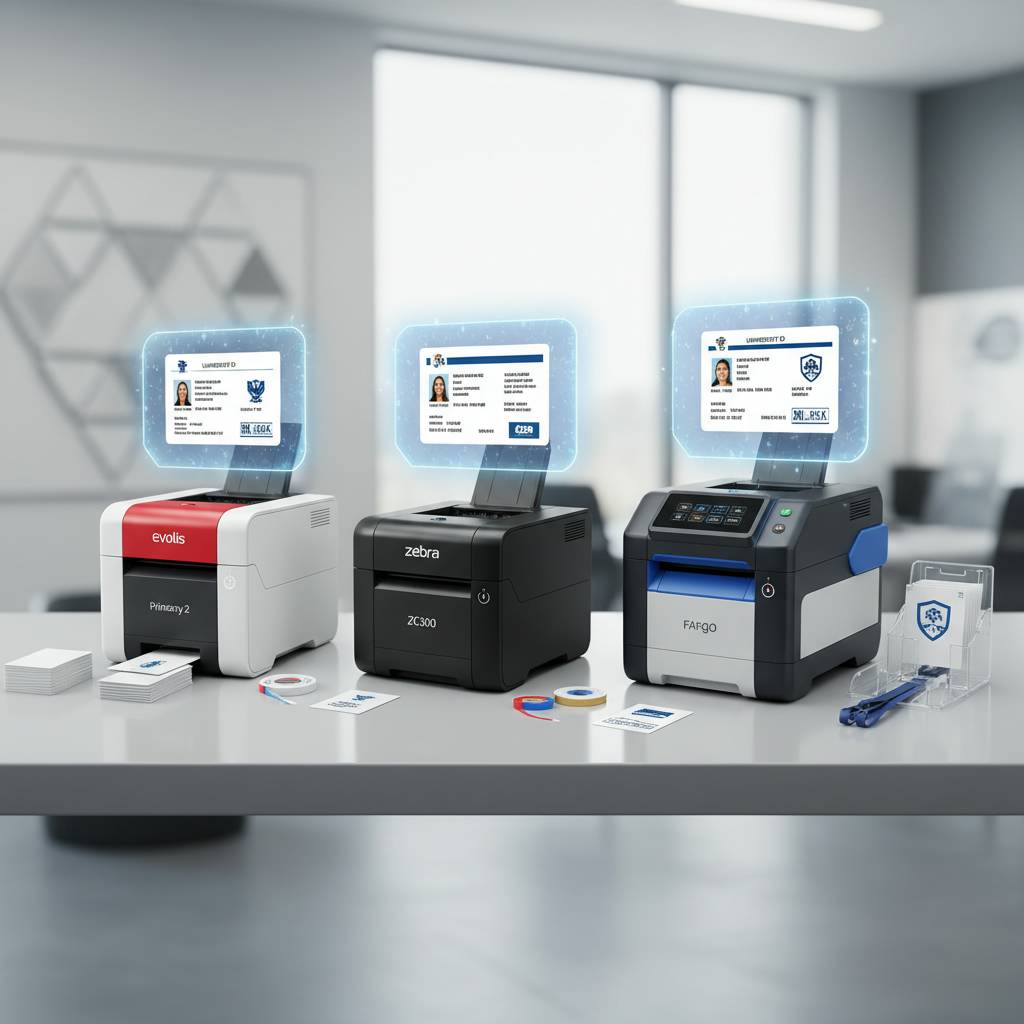 Carrying printers from four industry-leading brands - Evolis, Fargo, Zebra, and Matica - means Plastic Card ID isn't locked into recommending a single manufacturer's answer to every problem. Each brand has genuine strengths, and matching the right brand to a specific institutional need produces better long-term outcomes than defaulting to one name every time.
Evolis: Versatility Across All Volume Tiers
Evolis printers span the widest range of the lineup, from the entry-level Badgy200 to the high-performance Agilia. What makes Evolis equipment particularly attractive for educational institutions is the modular design philosophy: start with a base unit and add encoding, dual-sided printing, or lamination as the program grows. You're not locked into a configuration that doesn't fit future needs.
The Primacy2 in particular has become a favorite for mid-sized schools and colleges that need reliable dual-sided output with encoding flexibility. It handles the daily demands of an active student ID card program without drama, which is exactly what an office manager or IT administrator wants from a piece of hardware they depend on every single day.
Fargo and Zebra: Security-Focused ID Programs
Fargo printers bring a security emphasis that resonates with institutions running access control programs or producing credentials that need to resist tampering. Fargo's HDP (High Definition Printing) technology prints on a film before transferring the image to the card, producing an exceptionally smooth, tamper-evident surface. For high-security student ID applications, that distinction matters.
Zebra brings robust build quality and reliable performance to mid-volume ID programs. Zebra's ZC series printers are engineered for institutions that need consistent, day-in-day-out reliability with minimal downtime. Both Fargo and Zebra equipment integrates well with institutional identity management systems, which smooths deployment in larger or more complex environments.
Matica for High-Speed Event Applications
The Matica Event Printer occupies a specialized but valuable niche. Large universities running orientation week across multiple venues, athletic departments producing game-day credentials, or districts managing annual enrollment fairs all face moments where card printing speed becomes the primary requirement. Matica is built for exactly those moments.
Pairing a Matica event printer with a standard desktop unit for daily operations gives an institution coverage across both its routine workflow and its high-demand peaks. Plastic Card ID can help structure that kind of multi-printer program to ensure supply compatibility and operational continuity.
Frequently Asked Questions About Student ID Card Printers
 When institutions begin evaluating plastic card printers for student ID cards, the same questions tend to surface repeatedly. Addressing them directly saves time and helps administrators move toward confident purchasing decisions without unnecessary back-and-forth.
What Card Stock Do These Printers Use?
All printers in the Plastic Card ID lineup print on standard CR80 PVC card stock - the same size and thickness as a standard credit card. This format is universally compatible with card carriers, lanyards, badge holders, and access control readers already in use at most institutions. Cards with magnetic stripe or smart chip features require specialty card stock with the appropriate embedded components.
Card stock quality directly affects print output. Lower-grade blank cards can introduce print inconsistencies, surface irregularities, and encoding errors. Sourcing card stock through Plastic Card ID ensures compatibility with your specific printer model and ribbon combination.
How Long Does It Take to Print a Single Student ID Card?
Print times vary by model and configuration. Single-sided color printing on a mid-range unit like the Evolis Zenius or Primacy2 typically completes in under 30 seconds per card. Dual-sided printing with encoding adds time but still routinely completes well under two minutes for a fully personalized, encoded credential. High-speed models like the Matica event printer are engineered for even faster throughput when volume demands it.
For most student ID card applications, the bottleneck is rarely the printer itself - it's the data capture and card design workflow feeding it. Well-organized enrollment data and a clean card template make the actual printing step almost instantaneous in practice.
Can These Printers Encode Magnetic Stripes and Smart Chips?
Yes - and this is one of the most powerful capabilities of in-house card printing. Magnetic stripe encoding writes track data directly to the card's magnetic stripe during the print process, turning a photo ID into a functional swipe card for meal plans, library systems, or time-and-attendance tracking. Smart chip encoding works similarly for contactless or contact chip cards used in access control systems.
- Magnetic stripe encoding: compatible with meal plan systems, attendance tracking, and basic access control
- Smart chip encoding: suitable for contactless access control, transit integration, and higher-security applications
- Encoding upgrades are available as modular add-ons for select printer models, preserving your base hardware investment
- All encoding happens on-site, keeping student data within the institution's control
- Compatible card stock with embedded mag stripe or chip must be used - Plastic Card ID supplies both
Buyer Tips Before You Choose a Student ID Card Printer
Purchasing a plastic card printer for student ID cards involves more decisions than the printer model alone. Getting those surrounding decisions right determines whether the program runs smoothly from day one or requires costly adjustments shortly after deployment. A few considerations consistently make the difference between a successful rollout and a frustrating one.
Calculate Your True Annual Card Volume
Start with enrollment numbers and add an estimate for replacement cards - students lose cards, cards get damaged, and program changes sometimes require reissue. A school with 800 students might assume 800 cards per year, but replacement rates of 20-30% are common, pushing realistic volume to 1,000 or more. Plan for actual demand, not best-case demand.
Also consider seasonal spikes. Fall semester enrollment, new school year starts, and orientation periods compress card demand into short windows. A printer that handles average monthly volume comfortably may struggle during peak weeks. Factoring in peak demand alongside annual totals produces a more realistic sizing decision.
Think About the Full Card Program, Not Just the Printer
The printer is the centerpiece, but the program around it - card design software, ID capture webcams or cameras, card stock, ribbons, lanyards, badge holders - all need to work together. CPE supplies the printer hardware and the consumables that keep it running, which simplifies vendor management considerably for institutions that prefer a single, reliable source for their card program components.
Card sleeves and carriers extend the working life of printed student ID cards by protecting the surface from daily handling. For students who carry cards loose in a backpack pocket, a simple card sleeve dramatically reduces replacement frequency - which translates directly to lower ongoing supply costs for the institution.
Ask About Support and Replacement Supplies Before You Buy
Hardware reliability matters, but so does what happens when a ribbon runs out mid-semester or a printer needs a cleaning kit. Knowing your supply source is stocked and responsive removes a significant operational risk. Plastic Card ID maintains supply inventory for all printer models in the lineup and can be reached at 800.835.7919 for fast support on supply orders, compatibility questions, or hardware inquiries.
Before finalizing any printer purchase, confirm the long-term availability of compatible ribbons, cleaning supplies, and any encoding materials specific to your card program's requirements. A printer whose supplies are hard to source becomes a liability, not an asset, over time.
Build a Student ID Card Program That Works - Plastic Card ID
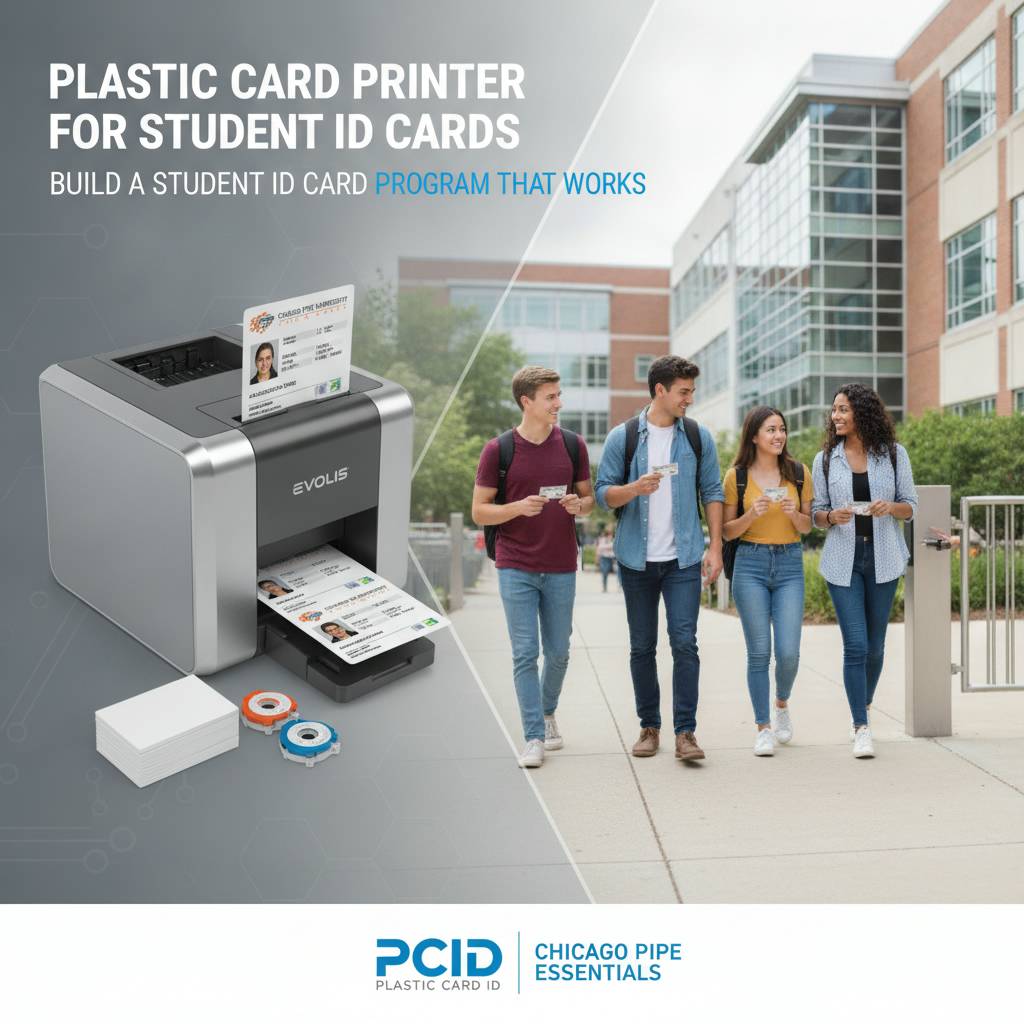 There's a reason institutions across every segment of U.S. education have moved toward in-house card printing over the past decade. The control it provides - over design, over data, over timing, over encoding - simply cannot be replicated by any outsourced solution. A student walks in needing a replacement ID on a Friday afternoon? Print it. A new transfer student starts Monday? Their card is ready before lunch. That responsiveness is the operational reality that in-house printing creates.
The printer models, brands, supplies, and encoding capabilities in Plastic Card ID's lineup cover every scenario that a student ID card program might encounter - from the smallest private school issuing a few hundred cards annually to the large public university processing thousands of credentials every semester. The right solution exists for every institution, at every scale.
With over 25 years of experience and more than 100,000 customers served nationwide, CPE brings genuine expertise to every inquiry - not just a product catalog. The team understands card programs, not just printer specs, and that distinction shapes the quality of guidance available to every institution that calls.
Ready to bring your student ID card program in-house? Contact Plastic Card ID today at 800.835.7919 and let our team match you with the right plastic card printer for student ID cards, supplies, and encoding configuration for your institution's exact needs.
Plastic Card Printer for Membership Cards & ID Badges
Previous Page