Card Printer Cost Per Card Breakdown: Budget Smarter
Table of Contents []
- Understanding Card Printer Cost Per Card: A Complete Breakdown by Plastic Card ID
- What Actually Goes Into Your Cost Per Card?
- Consumables Cost Breakdown: Ribbons, Cards, and Cleaning
- How Encoding Options Affect Your Per-Card Cost
- Volume vs. Quality: Choosing the Right Printer Tier for Your Cost Goals
- In-House Printing vs. Outsourced Vendors: The Real Cost Comparison
- Buyer Tips: Getting the Lowest Cost Per Card for Your Program
- Get Your Card Program Cost Per Card Right With Plastic Card ID
Understanding Card Printer Cost Per Card: A Complete Breakdown by Plastic Card ID
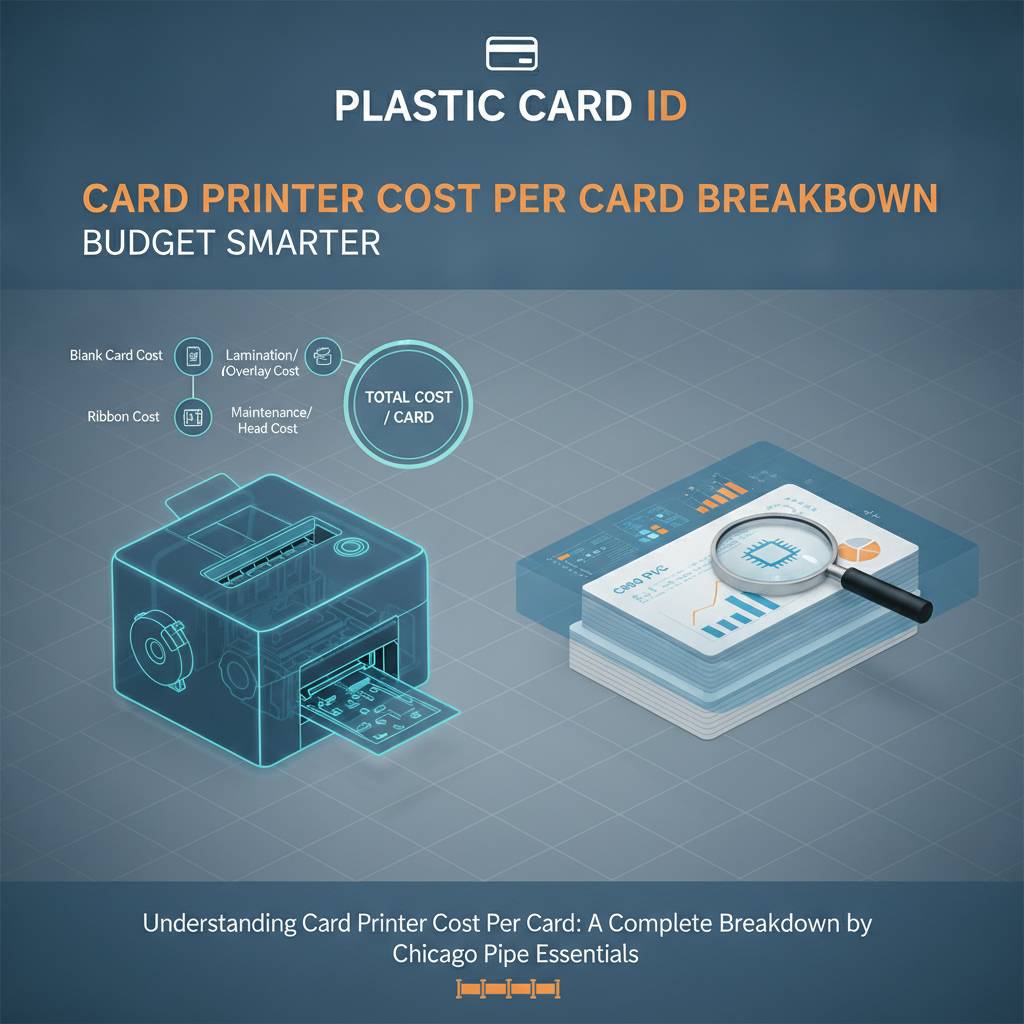 Most buyers fixate on the sticker price of a card printer and walk away thinking they understand their budget. They don't - not fully, anyway. The real financial picture of running an in-house card program lives in a number that rarely appears on a product page: cost per card. Once you understand how that number is calculated, every purchasing decision becomes sharper, smarter, and more defensible.
Whether you're printing employee badges for a 30-person office or cranking out membership cards by the thousands, knowing your true per-card cost separates an efficient program from an expensive guessing game. This guide breaks down every component that feeds into that number - hardware, consumables, maintenance, and more - so you can plan with confidence.
| Printer Tier | Example Model | Cards Per Month | Estimated Cost Per Card | Best For |
|---|---|---|---|---|
| Entry-Level | Evolis Badgy200 | Under 80 | $0.35-$0.75 | Small orgs, low volume |
| Mid-Range | Evolis Zenius / Primacy2 | 1,000-6,000 | $0.18-$0.45 | Mid-size businesses |
| Professional | Evolis Agilia | 6,000 | $0.12-$0.30 | High-volume programs |
| Security / ID | Fargo / Zebra | Varies | $0.20-$0.55 | Government, corporate security |
| Event / On-Site | Matica Event Printer | High-speed bursts | $0.15-$0.40 | Conferences, events |
What Actually Goes Into Your Cost Per Card?
 Here's something that surprises first-time buyers: the printer itself is often the smallest portion of your long-term expense. Over a three-to-five year lifecycle, the consumables - ribbons, blank cards, cleaning kits, lamination film - typically account for 60-80% of total program cost. That math changes how you should think about every purchasing decision.
Cost per card is calculated by dividing total program costs over a given period by the number of cards produced. That sounds simple enough, but the inputs are surprisingly layered. Hardware amortization, ribbon yield, dual-sided printing penalty, encoding upgrades, and cleaning frequency all contribute to the final number. Getting that number right isn't nitpicking; it's basic business sense.
Hardware Amortization: Spreading the Printer Cost
A printer like the Evolis Badgy200 costs significantly less upfront than a Fargo or Zebra professional unit, but amortization reveals the real story. Divide your printer's purchase price by the total expected cards printed over its useful life, and you get your hardware cost per card. For high-volume printers running thousands of cards monthly, this per-card contribution drops fast.
For example, a mid-range printer purchased at $600-$900 and used to produce 50,000 cards over its lifespan contributes roughly $0.01-$0.02 per card in hardware cost alone. That's a rounding error compared to ribbon cost. Buying a more capable printer often lowers your total cost per card - even if it feels more expensive at checkout.
Ribbon Yield: The Biggest Variable in Your Budget
Ribbon cost is where most programs feel the pinch. A standard YMCKO ribbon - the most common full-color option - typically prints 200-500 cards per roll depending on the printer model and card coverage. If your ribbon costs $45-$90 per roll and yields 250 cards, you're spending roughly $0.18-$0.36 per card on ribbon alone before factoring in anything else.
Monochrome ribbons change the equation dramatically. Black monochrome ribbons can yield 1,000-1,500 prints per roll at a fraction of the YMCKO cost, making them ideal for text-heavy access control cards or internal ID badges where full color isn't necessary. CPE supplies a full range of ribbon types so customers can choose the right consumable for their actual use case rather than over-specifying and overspending.
Single-Sided vs. Dual-Sided Printing Costs
Adding a second side to your card doesn't just double the ribbon use - it also increases wear on the printer's flip mechanism, raises cleaning frequency, and can reduce the overall throughput of your print runs. Dual-sided printing typically increases per-card cost by 30-60% compared to single-sided output, depending on the ribbon type and card design complexity.
That said, dual-sided cards often eliminate the need for separate card carriers or inserts, which have their own cost. When you weigh the total cost of a dual-sided card program against a single-sided card paired with a printed sleeve or carrier, the difference narrows considerably. The Evolis Primacy2 handles both configurations efficiently, giving operators the flexibility to make that call based on real numbers rather than guesswork.
Consumables Cost Breakdown: Ribbons, Cards, and Cleaning
Let's get specific about what you're actually buying on a recurring basis. Blank PVC cards are the substrate - the physical card stock that goes through the printer. Standard CR80 PVC cards run $0.03-$0.12 per card depending on quantity ordered, card thickness, and whether you're ordering plain white stock or pre-printed composite cards with security features.
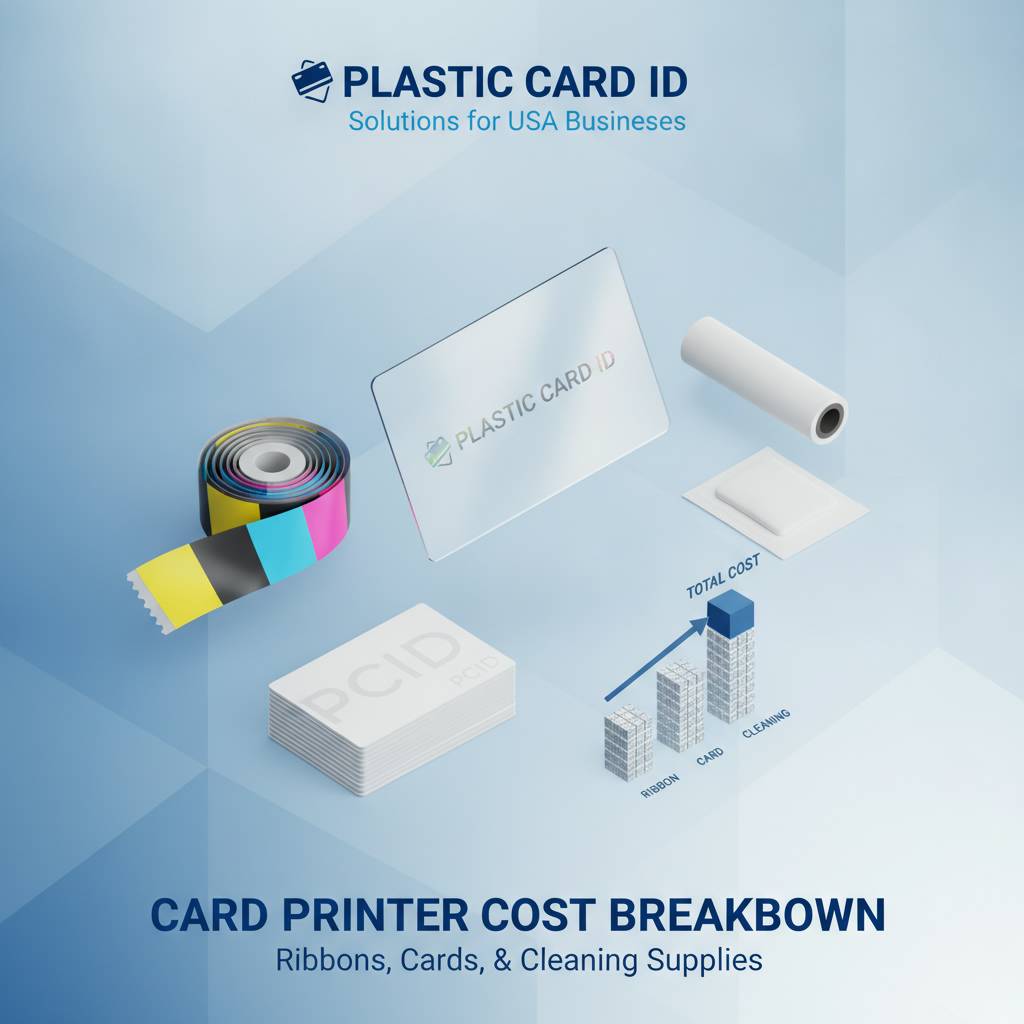
Ribbons vary considerably by type, printer compatibility, and yield. Cleaning kits - often overlooked entirely - should be factored in as a genuine line item. Skipping regular cleaning cycles causes print head degradation, card jams, color banding, and ultimately premature hardware failure. A $15-$25 cleaning kit used properly every 500-1,000 cards is some of the cheapest insurance you'll ever buy.
Comparing Ribbon Types by Cost Per Card
- YMCKO (Full Color with Overlay): Most commonly used. Typically $0.15-$0.40 per card in ribbon cost. Ideal for photo IDs, loyalty cards, event badges.
- YMCKOK (Dual Resin Black Panel): Adds a second black panel for sharper barcodes and text on the back. Slightly higher per-card cost, often $0.20-$0.45.
- Monochrome Black: Lowest cost per card at $0.03-$0.08. Best for access control cards, back-of-card text printing, or high-volume internal badges.
- Specialty Ribbons (Silver, Gold, White, UV): Higher cost per card, typically $0.25-$0.60. Used for security overlays, metallic branding, or invisible UV markings.
- Half-Panel / Economical Ribbons: Designed to reduce waste on cards with small print areas. Can reduce per-card ribbon cost by 15-25% in the right application.
Selecting the right ribbon type for your specific card design is one of the easiest ways to reduce cost per card without sacrificing quality. CPE can help match ribbon type to card program requirements across every brand in the lineup.
Blank Card Stock and Its Effect on Total Cost
Card stock seems like the boring part of the equation, but it actually has a meaningful impact on both per-card cost and print quality. Thin, low-quality PVC cards can cause misfeeds and jams that waste ribbon and time. Ordering in larger quantities - 500 or 1,000 cards at a time versus 100 - often drops the per-unit cost significantly, improving your overall cost per card without any change to your process.
For programs requiring magnetic stripe encoding, smart chip embedding, or dual-interface capabilities, the blank card substrate cost rises to reflect those added features - anywhere from $0.15-$0.60 per card just for the stock. Factor that in when calculating cost per card for access control or hotel key card programs, where these features aren't optional.
Cleaning and Maintenance Costs Over Time
Professional card printer brands like Evolis, Fargo, and Zebra design their printers to alert the operator when cleaning is due - typically every 500-1,000 print cycles. A cleaning kit from CPE includes cleaning cards, cleaning swabs, and cleaning rollers, running roughly $15-$35 depending on the printer model and kit contents. Spread across 1,000 cards, that's $0.01-$0.03 per card - a negligible but real cost that belongs in your calculation.
Ignoring maintenance doesn't make this cost disappear. It transfers it to print head replacement or full unit repair, which can run $150-$400 or more depending on the printer. Consistent maintenance is the single most overlooked factor in total cost per card calculations - and the one that catches most programs off guard after 18-24 months of operation.
How Encoding Options Affect Your Per-Card Cost
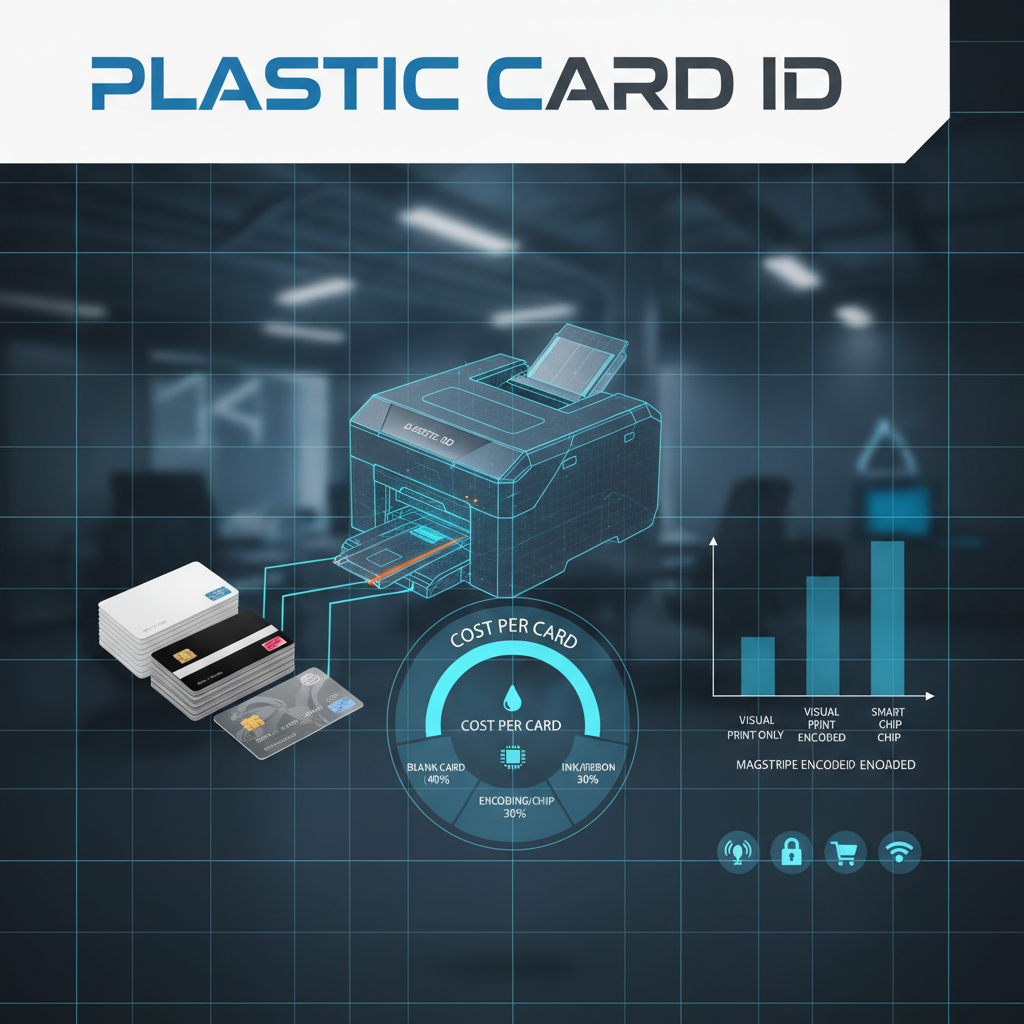 Magnetic stripe encoding, smart card chip writing, and proximity card encoding all add layers to both the hardware cost and the per-card cost. These aren't exotic features reserved for large enterprises - hotel key cards, gym memberships, campus IDs, and access control systems all rely on encoded cards as part of their daily operations.
Encoding happens at the printer level through optional modules or factory-installed hardware. Printers like the Evolis Primacy2, Fargo, and Zebra offerings support encoding upgrades that can be specified at purchase or added later. Understanding the encoding cost before you buy the printer prevents expensive upgrade regrets down the road.
Magnetic Stripe Encoding Cost Per Card
Adding magnetic stripe encoding capability to a printer - or purchasing a printer that includes it - typically adds $150-$400 to the hardware cost depending on the brand and configuration. The blank cards with magnetic stripes (Hi-Co or Lo-Co) cost more per card than plain PVC stock, usually $0.08-$0.20 per card for the stripe feature alone. Over a high-volume program, this adds up fast and belongs prominently in any cost per card analysis.
For programs like hotel key systems, retail loyalty cards, or access control, magnetic stripe encoding is non-negotiable. The good news is that once the encoding hardware is in place, the per-card cost increment is relatively fixed and predictable - making budget forecasting considerably more reliable than programs relying on third-party vendors for encoding services.
Smart Card and Chip Encoding
Smart card encoding - writing data to embedded microchips in the card - commands a higher per-card substrate cost, often $0.40-$1.50 per blank card depending on chip type and standards compliance. The encoder module itself adds hardware cost, but the ability to issue and re-issue smart cards entirely in-house eliminates significant vendor dependency and lead time. For campus ID programs, corporate access systems, or transit credentials, that independence has measurable financial and operational value.
Contact and contactless (RFID) chip cards each have their own cost profile. Contactless cards using MIFARE or other proximity standards tend to be slightly more expensive per card but are increasingly preferred for health, hygiene, and convenience reasons in high-traffic environments. CPE stocks compatible blank cards across these categories to keep programs running without supply chain surprises.
Reach Out for Encoding Configuration Guidance
Choosing the right encoding setup for your card program involves more variables than most buyers expect. Card type, chip standard, software compatibility, and print volume all factor into the recommendation. The team at Plastic Card ID is available at 800.835.7919 to walk through encoding requirements and match you with the right printer configuration from day one - no guesswork, no costly mismatches.
Volume vs. Quality: Choosing the Right Printer Tier for Your Cost Goals
 One of the most common mistakes buyers make is purchasing a printer at the wrong tier for their volume. An entry-level printer at a high-volume operation produces higher per-card costs through faster ribbon depletion, more frequent maintenance needs, and shorter hardware lifespan. Conversely, over-buying capacity for a program printing 200 cards a year locks capital into hardware that's never fully utilized.
The sweet spot is always a printer tier that matches your realistic monthly volume with a comfortable buffer for growth. That alignment minimizes per-card costs while preserving operational flexibility. CPE has spent over 25 years helping organizations across the United States make exactly this calculation correctly the first time.
Entry-Level Printers: When Low Volume Is a Feature
The Evolis Badgy200 is purpose-built for organizations printing fewer than 1,000 cards per year - schools managing student IDs for a single class cohort, small gyms issuing membership cards, or nonprofits producing volunteer credentials. At this scale, the low hardware cost and simple operation make it the most cost-efficient choice, even if per-card ribbon costs are slightly higher than mid-range models.
Attempting to run a high-volume operation on an entry-level printer accelerates wear, increases consumable waste from test prints and jams, and shortens the printer's useful life. The math doesn't work - and experienced buyers know it. Volume matching is the single most important factor in achieving a low cost per card.
Mid-Range Workhorses: Where Most Programs Live
The Evolis Zenius and Primacy2 occupy the sweet spot for organizations printing between 1,000 and 6,000 cards per month. These printers combine robust construction, consistent print quality, and support for optional encoding modules - making them the most versatile units in the lineup. Their ribbon yield is optimized for sustained production runs, and their cleaning cycles are designed for realistic office or operations environments.
At this volume tier, cost per card can drop to the $0.18-$0.35 range for full-color YMCKO printing, depending on card coverage and ribbon selection. Organizations at this scale often find that switching from an outsourced card vendor to in-house production pays for the printer within the first six to twelve months of operation.
Premium and High-Volume Printers for Maximum Output
The Evolis Agilia is built for organizations demanding edge-to-edge, highest-quality output with consistent results across high production volumes. For programs producing 6,000 or more cards per month, the Agilia's throughput and print head longevity push per-card costs down into the $0.12-$0.30 range even for full-color production. The Matica Event Printer serves a different high-volume scenario - on-site badge printing at conferences, trade shows, or large-scale corporate events where speed and mobility matter as much as quality.
Fargo and Zebra printers round out the high-end options with a particular focus on security-grade ID programs. Government agencies, hospitals, universities, and corporate security departments running high-stakes credentialing programs find the Fargo and Zebra ecosystems well-suited to their compliance and durability requirements - even when the per-card cost runs slightly higher due to security ribbon and lamination demands.
In-House Printing vs. Outsourced Vendors: The Real Cost Comparison
Outsourced card printing services charge anywhere from $0.75-$3.00 per card depending on quantity, design complexity, and turnaround time. Add in shipping, minimum order quantities, revision charges, and the lead time cost of waiting a week or more for a reorder - and the true cost of outsourcing climbs well above what most organizations initially budget.
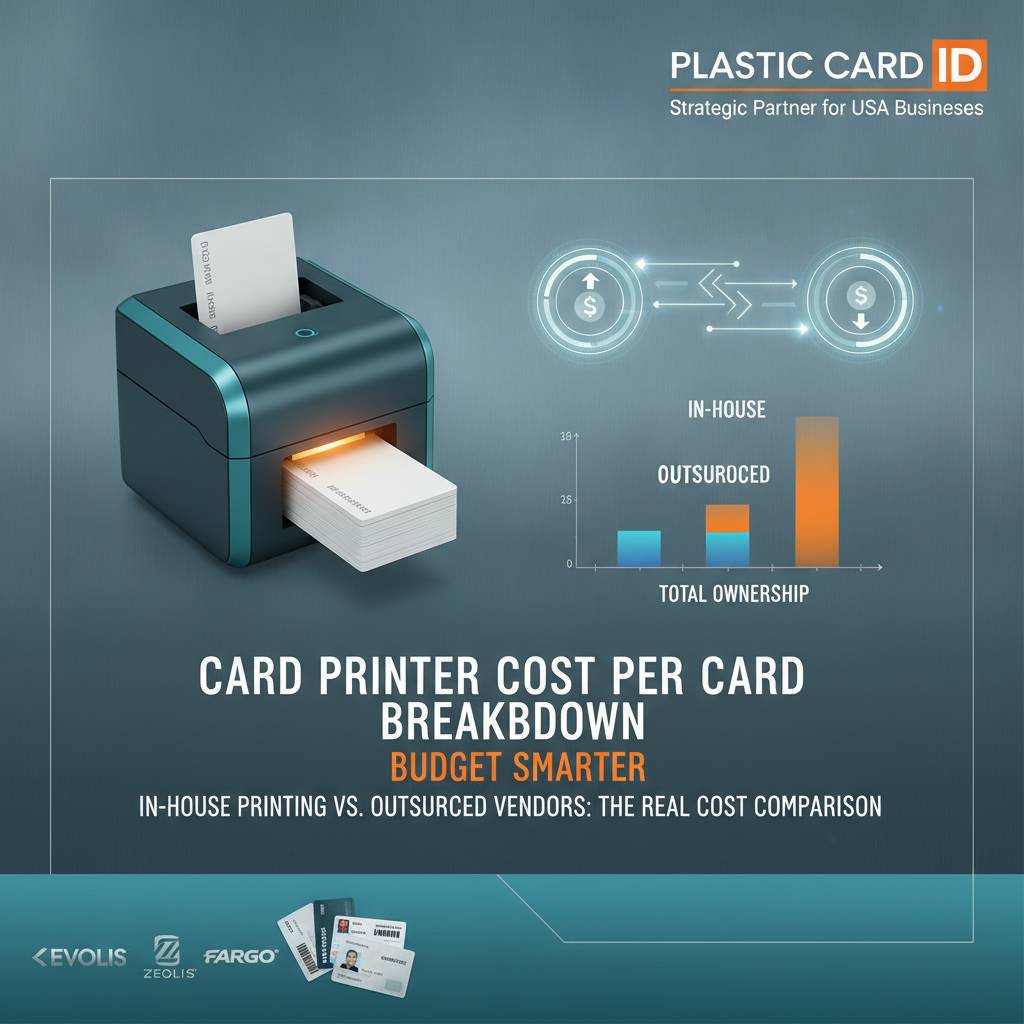
In-house printing, by contrast, delivers cards on demand with zero lead time. Print one card or one thousand without minimums, markups, or shipping delays. For organizations with variable card needs - new employee onboarding, membership renewals, event access credentials - that on-demand capability has real operational value that doesn't always appear in a direct cost comparison but absolutely affects the bottom line.
When In-House Printing Pays for Itself
The break-even point for switching from outsourced to in-house card printing depends on current vendor pricing and monthly card volume. At 200 cards per month from an outsourced vendor charging $1.50 per card, that's $300 per month in variable cost - $3,600 annually. A mid-range printer with consumables can produce those same 200 cards for $60-$90 per month. The hardware pays for itself within the first year, and every month after that is pure savings.
Beyond cost, in-house printing delivers a personalization capability that outsourced vendors simply can't match affordably. Each card can carry unique data - employee names, photos, membership numbers, encoded chip data - without per-card personalization surcharges. For organizations issuing photo ID cards, that capability alone justifies the switch.
Calculating Your Specific Break-Even Timeline
A straightforward break-even calculation requires four inputs: current vendor cost per card, expected monthly volume, estimated hardware cost, and estimated in-house consumable cost per card. Subtract the in-house cost from the vendor cost, divide the hardware investment by that monthly savings figure, and you have your break-even in months. Most mid-size programs hit break-even within six to eighteen months.
The team at Plastic Card ID regularly assists prospective customers in running this calculation. With a quarter-century of experience across more than 100,000 customers in the United States, CPE has seen virtually every card program scenario - and can deliver a realistic cost model for your specific situation rather than a generic estimate.
What Outsourcing Doesn't Tell You About Real Cost
Outsourced card vendors rarely advertise their reorder minimums, rush order fees, or revision charges upfront. When a card design changes - a logo refresh, a new magnetic stripe format, an updated barcode - outsourced programs face minimum reprint costs even if only a handful of cards are affected. In-house programs update the template in software and print exactly as many cards as needed. That flexibility is a cost advantage that compounds over time.
Buyer Tips: Getting the Lowest Cost Per Card for Your Program
 Smart purchasing decisions at the outset set the cost trajectory for the entire lifecycle of your card program. The right printer tier, ribbon selection, maintenance discipline, and card stock sourcing strategy all contribute to an optimized per-card cost. Here are the most effective levers buyers can pull to minimize cost without compromising quality or reliability.
Practical Tips to Reduce Your Per-Card Cost
- Match printer tier to volume: Avoid under-buying or over-buying capacity. Right-sizing the printer reduces per-card hardware amortization and lowers consumable waste from jams and test prints.
- Order ribbons in multipacks: Multi-ribbon bundles from CPE reduce per-roll cost and ensure you're never stopping production to reorder mid-run.
- Use monochrome ribbons for back-of-card text: If your dual-sided card only needs black text on the back, a YMCKO/KO ribbon combination dramatically reduces per-card cost versus full YMCKO on both sides.
- Order blank card stock in bulk: Per-card blank card cost drops meaningfully at 500 and 1,000 unit thresholds. Consistent card stock also reduces jams and wasted ribbon from misfeeds.
- Never skip cleaning cycles: Consistent maintenance extends print head life, preserves card quality, and avoids costly repair or replacement events that spike your effective per-card cost retroactively.
- Audit ribbon yield against card coverage: Cards with heavy full-bleed color coverage consume more ribbon per card than cards with white borders and moderate graphic coverage. Adjusting design templates can reduce ribbon use without visually impacting the card.
These aren't abstract recommendations - they're the practical habits of organizations that run card programs efficiently year after year. The lowest cost per card comes from a combination of smart hardware selection and disciplined operational practices, not from buying the cheapest printer on the market.
How to Evaluate Total Cost of Ownership Before You Buy
Total cost of ownership (TCO) for a card printer should account for hardware purchase price, expected consumable costs over a three-to-five year period, maintenance and cleaning supply costs, any encoding upgrade hardware required, and a reasonable estimate of print head replacement or service events. Add those up, divide by projected total cards printed over the period, and you have a realistic lifetime cost per card.
Buyers who skip the TCO calculation and buy on printer sticker price alone almost always find themselves surprised - usually around month eighteen when ribbon costs have accumulated and maintenance has been deferred. A well-built cost model at the start pays dividends for the entire life of the program. The experienced team at CPE can help build that model for any program scale or configuration.
Questions to Ask Before Purchasing Any Card Printer
Before committing to any printer, get clear answers to a short list of critical questions. What is the expected ribbon yield for your specific card design? Does the printer support the encoding type your program requires without an expensive upgrade module? What is the recommended cleaning frequency and what does a cleaning kit cost? How long is the manufacturer warranty and what does it cover? What is the expected print head lifespan and replacement cost?
These questions surface the operational realities that a spec sheet won't tell you. Asking them before purchase is the difference between a program that runs smoothly for years and one that generates constant budget surprises. Call Plastic Card ID directly - their team has the answers specific to each model in the lineup, not generic marketing copy.
Get Your Card Program Cost Per Card Right With Plastic Card ID
 There is no single "right" cost per card - there's only the right cost for your program, your volume, your card type, and your operational requirements. The variables are knowable. The math is manageable. And the right hardware and consumables, sourced from a supplier with the depth of experience to match product to program, make all the difference between a card program that drains budget and one that delivers genuine value.
Plastic Card ID has spent over 25 years and served more than 100,000 customers across the United States doing exactly this - matching organizations with the right Evolis, Fargo, Zebra, and Matica hardware and ensuring they have the ribbons, cleaning kits, encoding upgrades, and blank card stock to keep their programs running at optimized cost. CPE knows this space, knows these products, and knows how to help you get to the lowest sustainable cost per card for your specific situation.
Call 800.835.7919 today and speak with a Plastic Card ID specialist who will help you calculate your true cost per card and build a card program that performs at the highest level for years to come.