Direct-to-Card Printing vs Retransfer Printing: Key Differences
Table of Contents []
- Two Technologies, One Big Decision: Plastic Card ID Breaks It Down
- How Direct-to-Card Printing Actually Works
- Retransfer Printing: The Reverse Transfer Advantage
- Choosing the Right Printer for Your Volume and Use Case
- Accessories, Consumables, and the Full Card Program Ecosystem
- Frequently Asked Questions About Card Printing Technology
- Why In-House Card Printing Outperforms Outsourcing for Most Organizations
- Get the Right Technology From Plastic Card ID
Two Technologies, One Big Decision: Plastic Card ID Breaks It Down
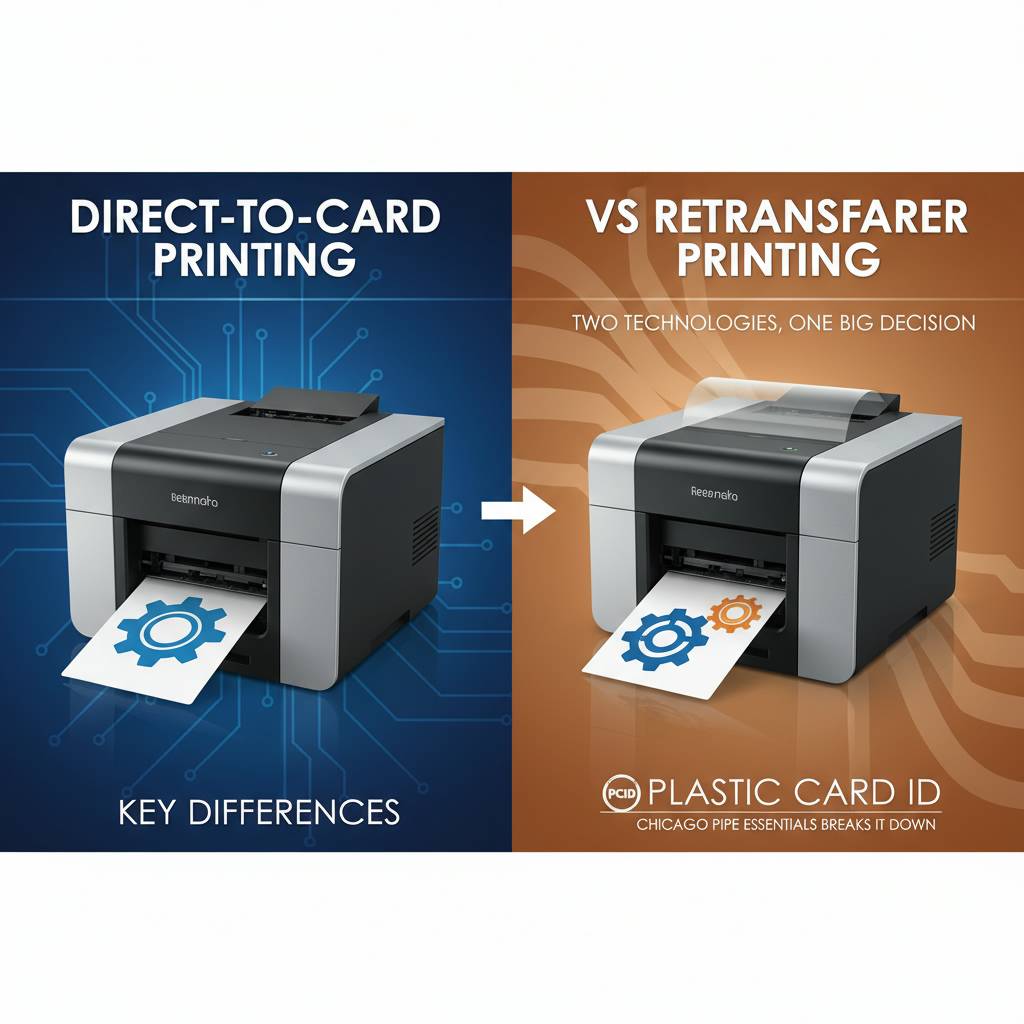 Walk into almost any HR department, university ID office, or membership organization that prints cards in-house, and you'll find someone who has wrestled with this exact question: direct-to-card or retransfer printing - which one actually fits what we need? It sounds technical, and in some ways it is. But the decision ultimately comes down to a handful of practical factors that any buyer can evaluate without an engineering degree.
The good news is that both technologies have matured significantly. Today's card printers, whether direct-to-card or retransfer, deliver professional results that would have been difficult to achieve with in-house equipment just fifteen years ago. CPE has helped more than 100,000 businesses across the United States navigate exactly this decision, and the patterns that emerge from that experience are genuinely useful.
This guide will walk you through how each technology works, where each one excels, where it stumbles, and how to make a confident purchasing decision without overspending - or underspending - for your application. Let's start with the fundamentals.
| Feature | Direct-to-Card (DTC) | Retransfer (Reverse Transfer) |
|---|---|---|
| Print Method | Printhead touches card surface | Image printed on film, then transferred to card |
| Edge-to-Edge Print | No (small border) | Yes (true oversize) |
| Image Quality | Excellent for most ID applications | Superior, especially on textured cards |
| Printhead Durability | Moderate (contacts card directly) | Higher (never touches card) |
| Cost per Card | Lower | Higher |
| Hardware Cost | Lower entry price | Higher entry price |
| Best For | Employee IDs, loyalty cards, membership cards | Access control, smart cards, high-security IDs |
How Direct-to-Card Printing Actually Works
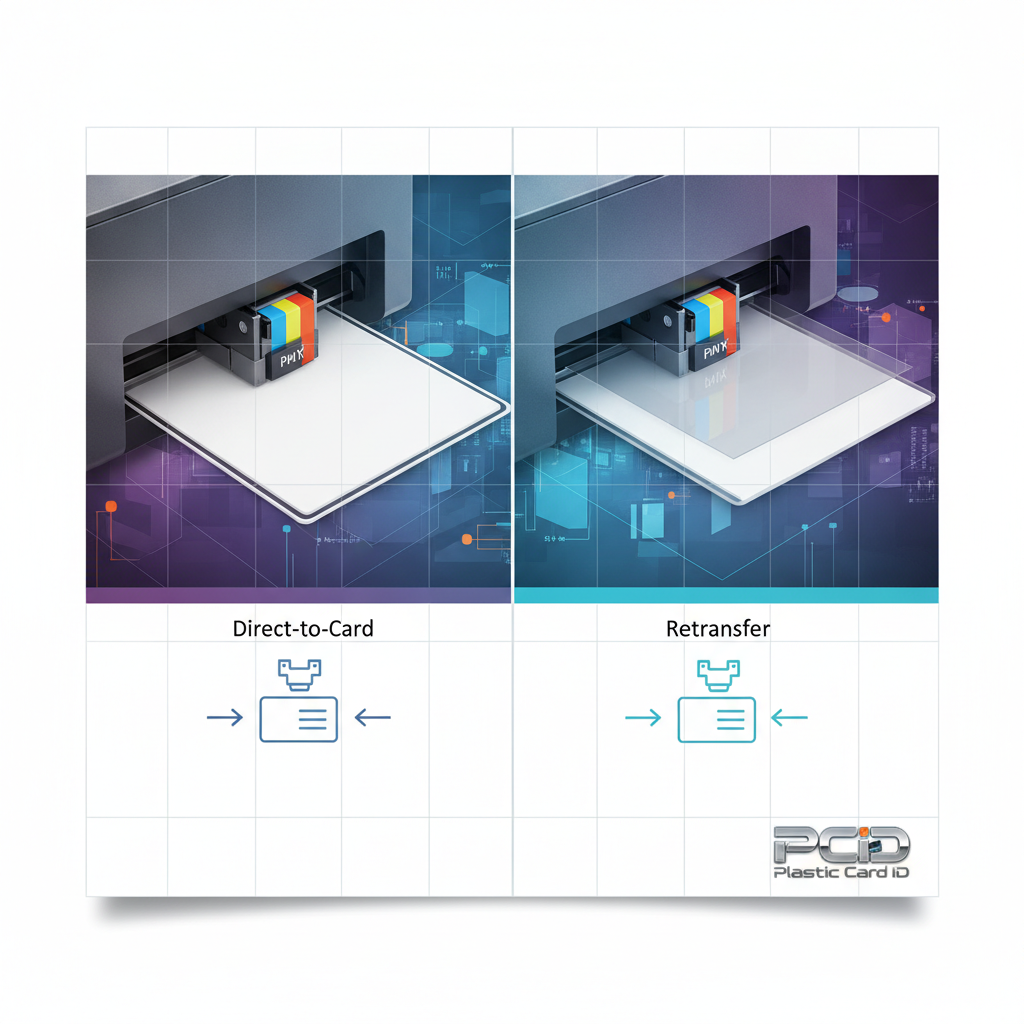 Direct-to-card printing - sometimes abbreviated DTC - is the technology you'll find in the majority of desktop card printers sold today. The process is refreshingly straightforward: a printhead containing hundreds of tiny heating elements moves across a ribbon (typically a YMCKO ribbon containing yellow, magenta, cyan, black, and overlay panels), transferring dye directly onto the surface of a PVC card. The printhead physically contacts the card, which is a detail that matters more than most buyers initially realize.
Because the dye is deposited directly onto the card's surface, the process is fast and cost-efficient. Ribbons for direct-to-card printers tend to cost less per card yield than retransfer film combinations, and the printers themselves have lower hardware acquisition costs. For organizations printing employee ID cards, loyalty programs, library cards, or internal access badges in standard volumes, DTC printing represents a highly practical solution with a short payback period.
The Role of the YMCKO Ribbon in DTC Output
The YMCKO ribbon is the workhorse consumable in direct-to-card printing. Each panel in the ribbon handles a different function: yellow, magenta, and cyan panels layer together to produce full-color photographic-quality images, the black panel applies crisp text and barcodes, and the overlay panel deposits a clear protective coating over the entire card surface. Choosing the right ribbon formulation for your card stock dramatically affects final image quality.
Beyond standard YMCKO ribbons, the DTC ecosystem supports monochrome ribbons in black, blue, red, gold, silver, and white - each ideal for single-color applications where cost efficiency matters. Specialty half-panel ribbons allow simultaneous full-color photo printing on one portion of the card and monochrome text on another, squeezing more yield out of each ribbon cartridge. CPE carries the full range of compatible ribbons for every printer brand in the lineup.
Understanding the Border Limitation
Here is where direct-to-card printing has a well-known constraint: the printhead cannot safely print all the way to the physical edge of the card. Most DTC printers leave a small unprintable border - typically around 0.5 to 1 millimeter - along all four edges. For most card designs, this is completely invisible in practical use. A photo ID badge, a gym membership card, a student ID - none of these applications typically require true edge-to-edge printing.
However, if your card design uses a full-bleed background image or a colored border that must reach the card's physical edge, the DTC border becomes noticeable. This is not a flaw in the technology; it is simply a physical consequence of how the printhead interacts with the card surface. Knowing this upfront prevents disappointment and guides you toward the right technology for your specific design requirements.
Printhead Lifespan and Maintenance in DTC Printers
Because the printhead makes direct contact with every card that passes through the printer, particles of dust, debris, and card material can accumulate over time. Regular cleaning using manufacturer-supplied cleaning kits is not optional - it is essential for maintaining consistent print quality and protecting the printhead investment. Most DTC printheads are rated for tens of thousands of cards when properly maintained.
Cleaning kits typically include cleaning cards pre-saturated with isopropyl alcohol solution and cleaning swabs for more targeted cleaning of rollers and transport components. Running a cleaning cycle every time you replace a ribbon cartridge takes under two minutes and meaningfully extends both printhead life and overall image quality. CPE supplies cleaning kits for every printer model in the catalog.
Retransfer Printing: The Reverse Transfer Advantage
Retransfer printing - also called reverse transfer printing - adds an elegant intermediate step to the process. Instead of depositing dye directly onto the card, the printer first creates the complete image on a clear retransfer film. That film is then thermally bonded to the card surface under heat and pressure. The result is an image that sits beneath a protective film layer rather than on top of the bare card surface. This single architectural difference produces a cascade of performance advantages.
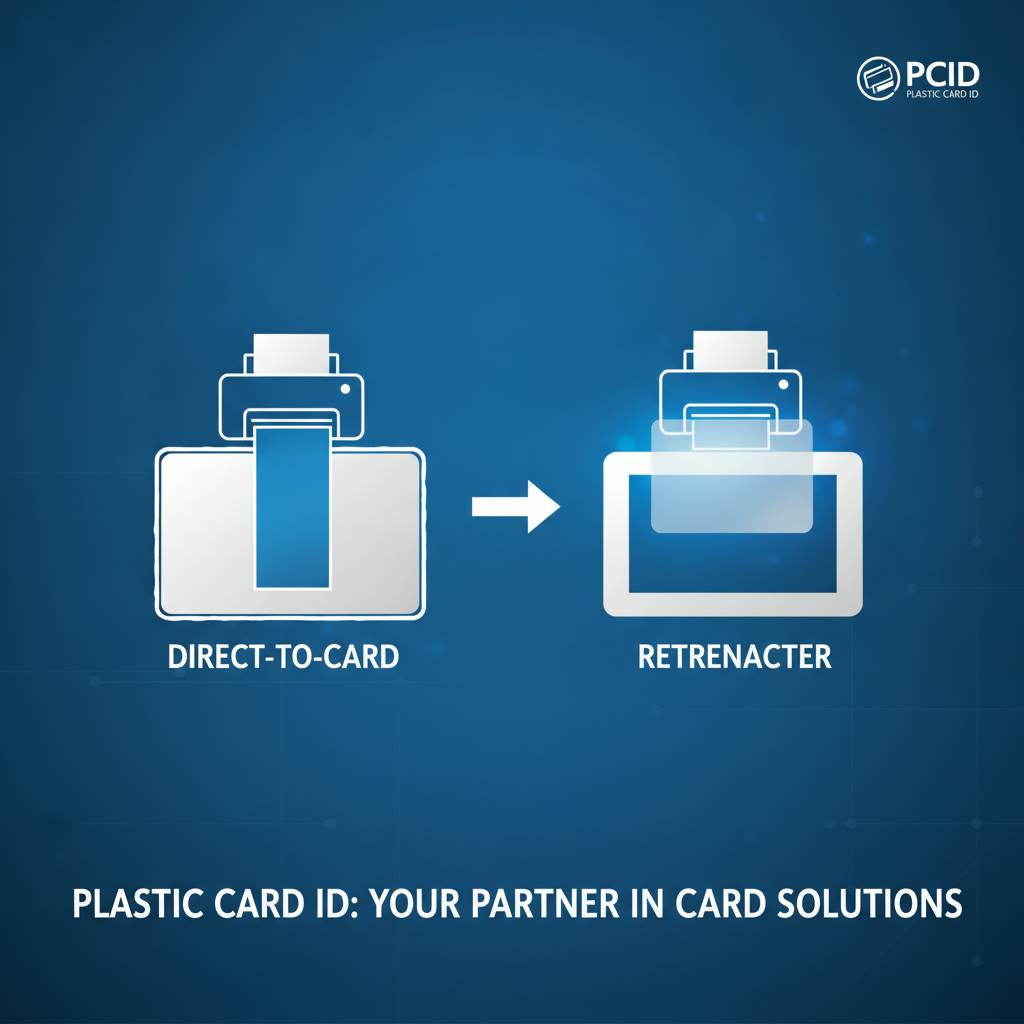
The most immediate benefit is true oversize, edge-to-edge printing. Because the image is applied on film that can extend slightly beyond the card's dimensions before being trimmed to fit, there is no unprintable border. Every millimeter of card real estate is available for your design. For organizations with branding standards that require full-bleed designs, this is not a luxury - it is a requirement.
Why Smart Cards and Security Cards Favor Retransfer
Smart cards and proximity cards for access control systems often have slightly uneven surfaces due to embedded chips, antennas, or other components. A direct-to-card printhead can struggle to maintain consistent contact across these surface variations, potentially producing streaked or incomplete print areas directly above embedded features. Retransfer printing sidesteps this entirely - the film bonds uniformly across the entire card surface regardless of what lies beneath it.
For high-security ID programs - government contractor badges, healthcare facility credentials, university smart IDs - the combination of edge-to-edge printing and compatibility with chip-embedded cards makes retransfer the preferred technology. Fargo's HDP series and Zebra's ZXP Series 8 are classic examples of retransfer printers built specifically for security-grade applications, and CPE carries both platforms alongside full consumable support.
Comparing Print Durability Between Technologies
One frequently overlooked advantage of retransfer printing is durability. Because the printed image is sealed beneath the retransfer film layer, it is protected from surface abrasion in a way that direct-to-card images - even those with an overlay panel - simply cannot match. Cards that are frequently swiped, scanned, or physically handled tend to show wear patterns over time with DTC cards, while retransfer-printed cards maintain their appearance significantly longer under equivalent use conditions.
For organizations where card longevity directly affects operational costs - replacing fewer cards means lower long-term spend - retransfer printing often justifies its higher per-card cost through extended card useful life. A hotel key card replaced every few months has different economics than a university ID expected to last four years of heavy daily use.
The Cost Reality of Retransfer Printing
Retransfer printing requires two consumable components where DTC requires one: the ink ribbon and the retransfer film. Combined, these consumables result in a higher cost per card compared to direct-to-card printing with an equivalent ribbon. Hardware costs are also higher - retransfer printers are more mechanically complex and correspondingly more expensive to purchase. Entry-level retransfer printers typically start in the range of $1,500-$3,500, while equivalent DTC models may run $500-$1,500.
That said, it is important to evaluate total cost of ownership rather than upfront cost alone. Retransfer printheads, because they never contact card surfaces directly, tend to outlast DTC printheads substantially. For high-volume applications, the reduced frequency of printhead replacement can offset a meaningful portion of the higher consumable cost over a multi-year operating period. Call 800.835.7919 to discuss which technology pencils out better for your specific volume and application.
Choosing the Right Printer for Your Volume and Use Case
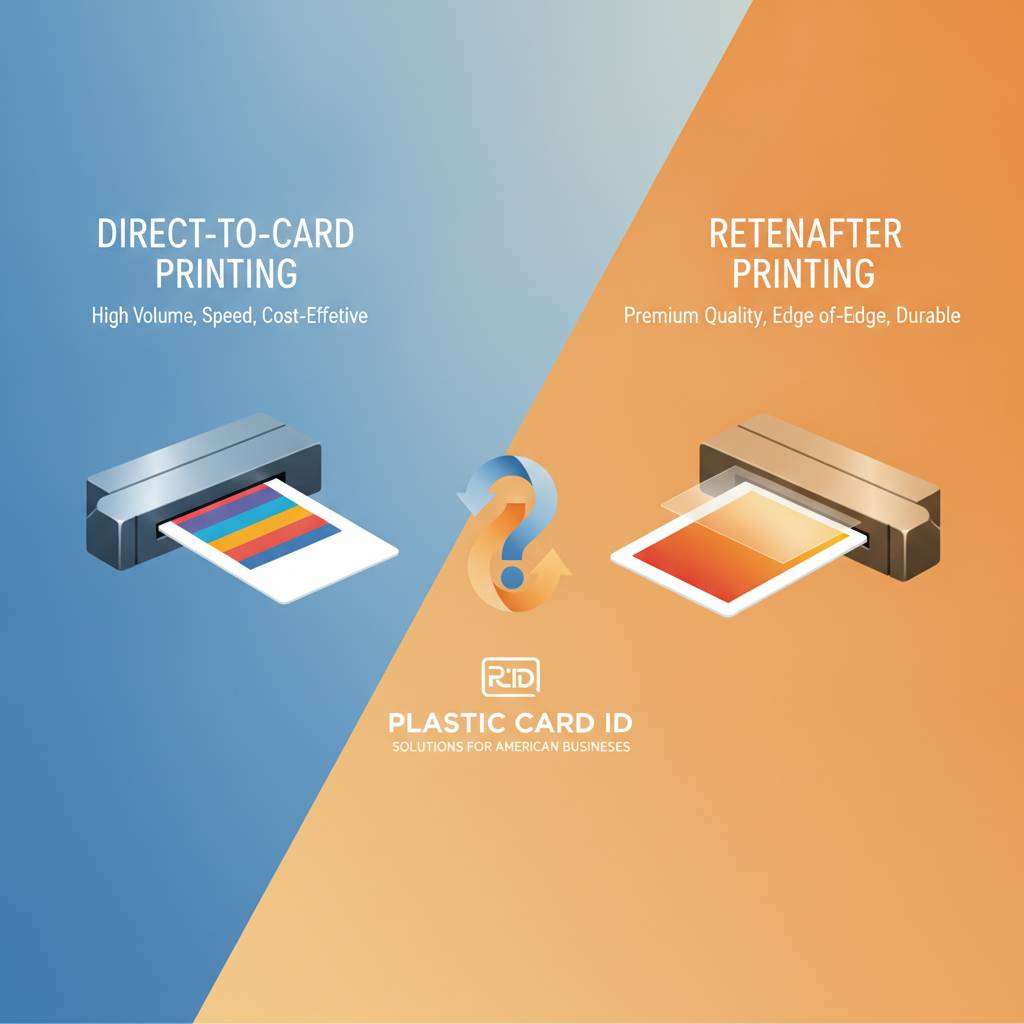 Technology selection does not happen in isolation - it happens in the context of how many cards you print per month, what those cards need to do, and what your budget allows. Volume is arguably the single most important filter to apply first, before diving into technology comparisons. A school district printing 200 student IDs once a year has completely different needs than a hospital system issuing and replacing access control cards continuously.
Once volume is established, the use case defines the technology floor. Organizations that only need photo IDs, loyalty cards, or basic membership cards can almost always be well-served by a quality direct-to-card printer. Organizations running smart card programs, producing high-security credentials, or requiring full-bleed designs should budget for retransfer from the outset.
Entry-Level DTC Printers: Evolis Badgy200 and Similar
The Evolis Badgy200 is an ideal starting point for organizations printing under 1,000 cards per year. It produces single-sided, full-color cards using standard YMCKO ribbons and operates with a compact footprint appropriate for any desk or counter. The Badgy200 is particularly popular with small nonprofits, membership clubs, and event organizers who need professional-quality results without industrial-scale investment.
At this volume level, direct-to-card printing is almost always the right choice. Retransfer's advantages are genuine, but they are most meaningful at higher volumes and in applications with specific surface or security requirements that entry-level users simply do not encounter. Matching the printer to the actual need - rather than overspecifying - is one of the most useful pieces of advice CPE consistently offers first-time buyers.
Mid-Range Workhorses: Evolis Zenius and Primacy2
Organizations printing 1,000 to 6,000 cards per month find strong value in mid-range DTC printers like the Evolis Zenius and Primacy2. Both models support optional encoding upgrades - magnetic stripe encoding and smart card chip encoding can be added as modules - giving them flexibility to grow with an evolving card program. The Primacy2 in particular offers dual-sided printing as an option, enabling organizations to carry information on both card faces without a separate flipper station.
Lamination module options compatible with some mid-range printers add another layer of physical protection and visual sophistication to issued cards, approaching some of the durability benefits that retransfer naturally provides. For organizations that need enhanced durability but are not ready to invest in a full retransfer platform, a DTC printer with lamination capability can bridge the gap effectively.
Premium and High-Volume Options
At the premium end of the DTC spectrum, the Evolis Agilia delivers edge-to-edge, highest-quality output in a format designed for organizations that demand visually exceptional cards. For pure speed and throughput, the Matica Event Printer handles high-volume on-site credential production - think large conferences, major corporate events, or university orientation days where hundreds of badges need to be produced and issued rapidly. Matching the right printer to peak-demand scenarios is as important as matching it to daily averages.
Fargo and Zebra retransfer platforms complete the upper tier of the lineup, providing the security-grade ID printing capability that government, healthcare, and enterprise access control programs require. These are not entry-level investments, but for organizations where card security and compliance genuinely matter, the cost of the right printer is dwarfed by the cost of a compromised credential program.
| Annual Volume | Recommended Technology | Example Models |
|---|---|---|
| Under 1,000 cards/year | Direct-to-Card | Evolis Badgy200 |
| 1,000-6,000 cards/month | Direct-to-Card with options | Evolis Zenius, Primacy2 |
| High-volume, edge-to-edge required | Retransfer or Premium DTC | Evolis Agilia, Fargo HDP, Zebra ZXP8 |
| On-site event badging | High-speed DTC | Matica Event Printer |
Accessories, Consumables, and the Full Card Program Ecosystem
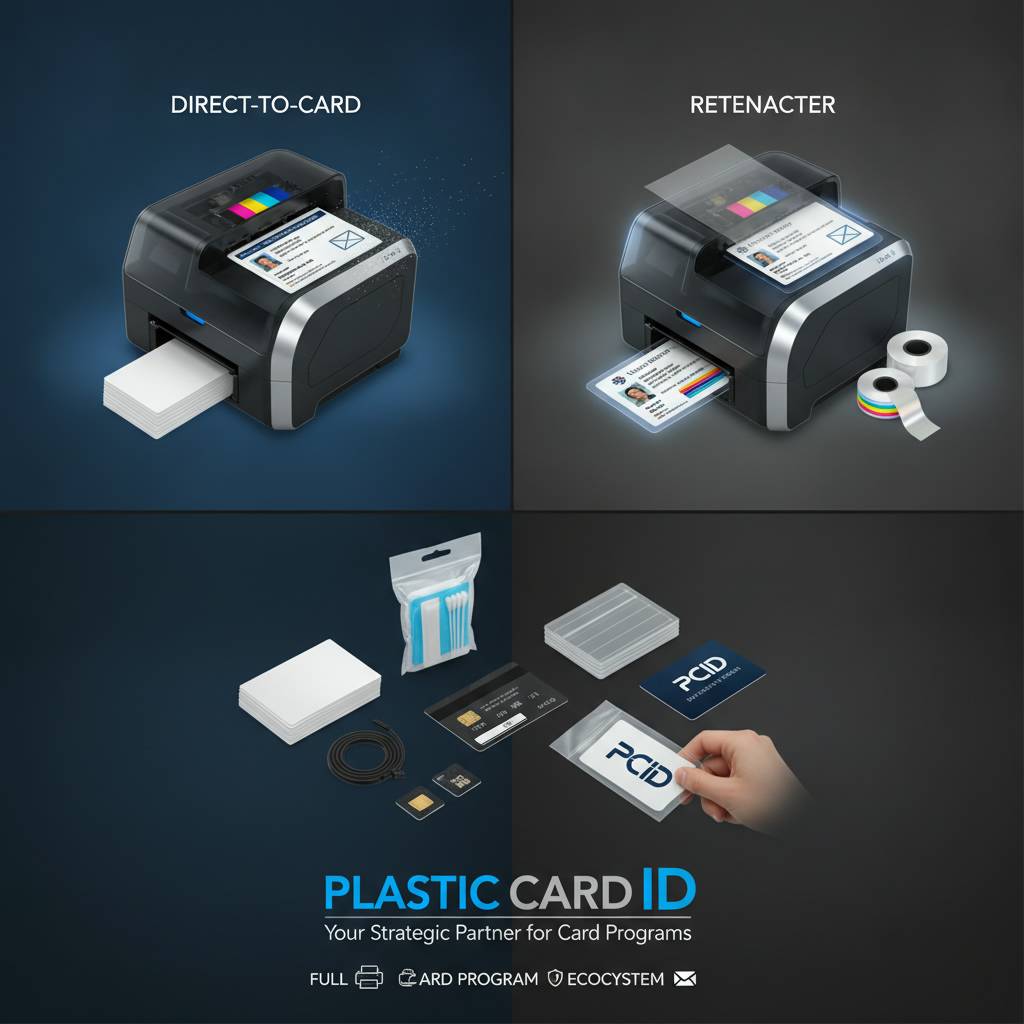 A printer is only one component of a functional card program. The supplies that feed that printer - and the accessories that expand its capabilities - are what determine whether your program runs smoothly day after day or turns into a procurement headache. Building a complete consumable strategy at the outset saves significant operational friction later.
Ribbons need to be stocked in sufficient quantity to avoid production stoppages during busy periods. Cleaning kits should be on hand before they are urgently needed - not ordered after print quality has already degraded. Encoding modules, lamination supplies, and card carriers all represent components of a mature card program that buyers should anticipate rather than discover reactively.
Ribbons: Matching the Consumable to the Application
Ribbon selection is more nuanced than it might initially appear. YMCKO full-color ribbons are the standard choice for photo ID and multi-color card designs. Monochrome ribbons - black being the most common - are dramatically more cost-efficient for high-volume applications where color is not required, yielding far more cards per ribbon at a lower cost per card. Selecting the right ribbon type for each use case is one of the most impactful cost-reduction moves available in any card printing program.
Half-panel ribbons (YMCKO-K and similar configurations) split the ribbon real estate between color panels for the photo area and a full-panel black section for text, delivering both capabilities from a single ribbon at better per-card economics than a pure YMCKO ribbon would offer at equivalent volumes. For organizations printing personalized photo IDs with significant text content, half-panel ribbons often represent the best balance of quality and cost.
Encoding Upgrades: Magnetic Stripe and Smart Chip
Many organizations discover, after initial purchase, that their card program needs to evolve. An employee ID that starts as a simple visual badge might later need to function as an access control credential, requiring magnetic stripe or smart chip encoding capability. Fortunately, most mid-range and above card printers support field-upgradeable encoding modules that can be added without replacing the printer itself.
Magnetic stripe encoding writes data to the stripe in ISO standard tracks, enabling compatibility with door readers, time-and-attendance systems, loyalty program terminals, and other standard mag-stripe infrastructure. Smart chip encoding supports contact and contactless chip technologies including HID, MIFARE, and other common access control standards. Planning for these capabilities at the time of initial purchase - even if they are not immediately needed - avoids the frustration of discovering a printer cannot be upgraded later. Reach out at 800.835.7919 to discuss which encoding options are available for a specific model before purchasing.
Input Hoppers, Card Carriers, and Sleeves
- Input hoppers expand the card feeder capacity of desktop printers, enabling longer unattended print runs without manually reloading cards.
- Card carriers are thin plastic transport sleeves used to safely guide fragile or specialty substrate cards through the printer mechanism without damage.
- Card sleeves and holders protect issued cards from surface wear during daily use, extending card useful life significantly in high-handling environments.
- Lamination modules apply a protective overlay film to printed cards, adding durability and optional visual effects like holographic or matte finishes.
- Cleaning kits should be treated as a regular consumable, not an afterthought - schedule cleaning cycles to maintain print quality and protect hardware investment.
Frequently Asked Questions About Card Printing Technology
After more than 25 years and over 100,000 customers served, certain questions come up again and again. The answers below reflect real-world experience across a wide range of industries and use cases.
Is Retransfer Printing Always Better Than Direct-to-Card?
Not at all - and this is an important point. Retransfer printing offers specific advantages that are genuinely meaningful in specific contexts: edge-to-edge printing, compatibility with uneven card surfaces, and superior durability under heavy physical handling. But for the majority of card printing applications - employee IDs, membership cards, loyalty programs, student IDs, event credentials on standard PVC cards - a well-maintained direct-to-card printer delivers excellent results at a lower total cost.
The temptation to over-specify is real, especially when buyers are making a multi-year hardware investment and want to ensure they do not regret the decision. But over-specifying also means over-spending on hardware and consumables for capabilities that will never be used in practice. The right printer is the one that matches actual requirements, not theoretical maximums.
Can I Upgrade My Existing DTC Printer to Retransfer?
No - direct-to-card and retransfer represent fundamentally different printer architectures. You cannot add a retransfer module to a DTC printer; they are built differently from the ground up. If your requirements evolve to the point where retransfer printing becomes necessary, the path forward is replacing the printer with a retransfer-capable model, not upgrading an existing DTC unit.
This is precisely why it is worth having an honest conversation about future requirements before making an initial purchase. If there is a reasonable probability that your card program will expand to include smart card printing, full-bleed design requirements, or high-security credential issuance within the next two to three years, factoring that into the initial purchase decision can save the cost of an early hardware replacement. CPE can help you think through this trajectory before you commit.
What Card Thickness Works With Each Technology?
Standard CR80 PVC cards at 30 mil thickness are compatible with virtually every card printer on the market, both DTC and retransfer. Most desktop printers also support thicker cards up to 40 mil for applications requiring a heavier feel. Retransfer printers generally handle a wider range of card substrates and thicknesses, including cards with embedded components that create surface irregularities - a direct consequence of the film transfer process that never makes printhead-to-card contact.
Specialty substrates, composite cards, and chip-embedded cards should always be verified against the specific printer model's specifications before purchase. Not all printers are rated for all card types, and using an incompatible substrate can damage the printhead or transport mechanism.
Why In-House Card Printing Outperforms Outsourcing for Most Organizations
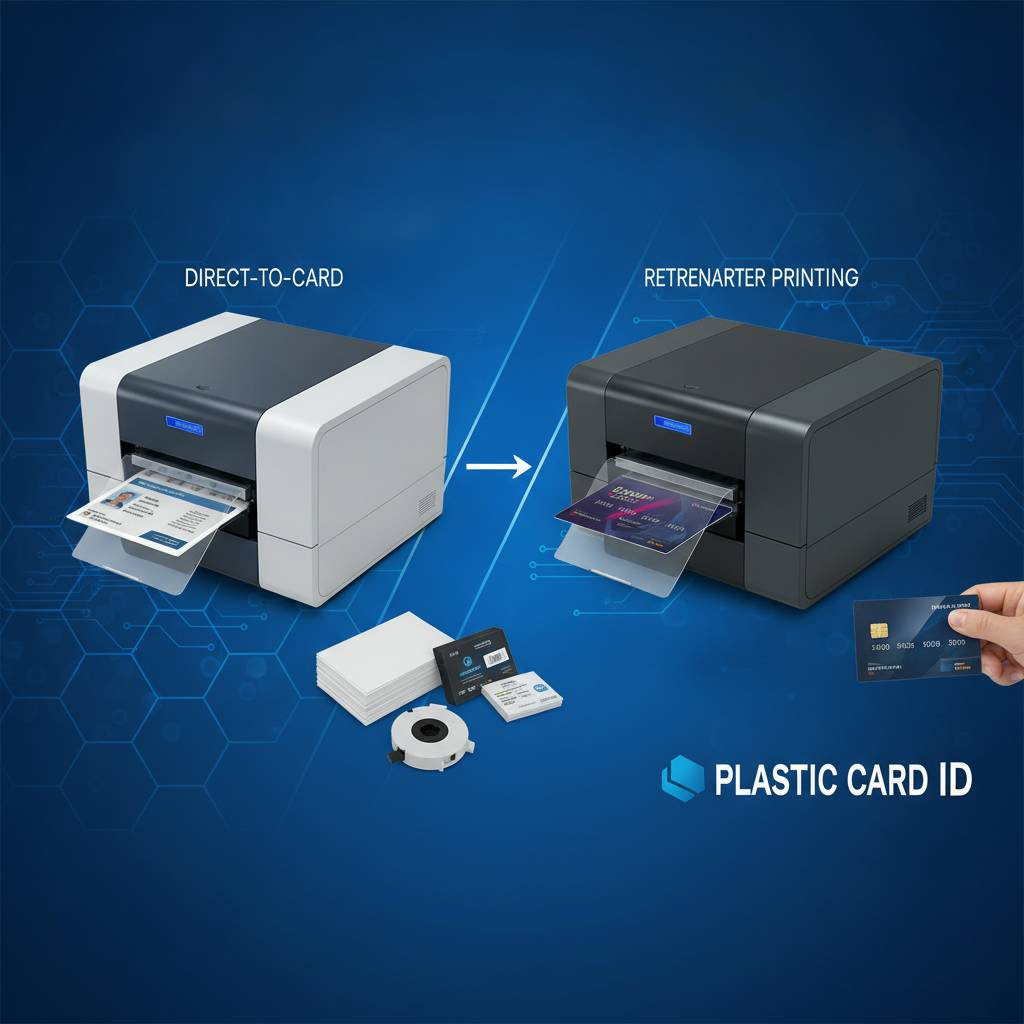 Organizations that have historically outsourced their card printing to third-party vendors often have a moment of realization when they calculate what they have been spending - and how long they have been waiting. Rush fees, minimum order quantities, lead times measured in days or weeks, and the inability to print a single replacement card on demand are recurring frustrations that in-house printing eliminates entirely.
Total control over the card program is perhaps the most underappreciated benefit of in-house printing. When an employee loses a badge on a Friday afternoon, you can reprint it in minutes rather than waiting for a vendor order cycle. When a membership card design changes, you update the template and print the new version immediately rather than discarding a large pre-printed inventory. When a hotel guest needs a new key card, the front desk handles it on the spot.
On-Demand Printing and Personalization Advantages
In-house printing enables true on-demand, personalized card production - one card at a time, customized with the specific individual's photo, name, employee number, encoded access data, or whatever information the card needs to carry. This is categorically different from ordering pre-printed generic cards in bulk. Personalization is not a premium feature you pay extra for; it is simply what in-house printing does by default.
Organizations running loyalty programs, membership clubs, or student ID systems particularly benefit from this capability. Cards can be issued at point of enrollment, immediately functional, personalized to the individual, and ready to use - without waiting for a batch order to arrive. The operational efficiency gains compound quickly in high-enrollment environments.
Eliminating Vendor Lead Times and Minimum Orders
Outsourced card printing typically involves minimum order quantities that force organizations to over-order, tying up budget in card inventory that may never be used. Design changes, program updates, or branding refreshes then result in wasted inventory that must be discarded. In-house printing eliminates both problems simultaneously - print exactly what you need, when you need it, with no minimums and no lead times.
For organizations that issue cards with time-sensitive information - expiration dates, event-specific credentials, temporary access cards - this flexibility has direct operational value. A conference that needs to print on-site registration badges for same-day walk-in attendees cannot afford a two-week vendor lead time. The Matica Event Printer and similar high-throughput models are built specifically for exactly these high-intensity, time-critical scenarios.
The Long-Term Financial Case for In-House Printing
The financial case for bringing card printing in-house typically becomes compelling well before most organizations expect it to. Hardware acquisition costs are a one-time investment; per-card consumable costs - ribbons, cleaning supplies, blank cards - are predictable and generally far lower than per-card outsourced pricing at equivalent volumes. Most organizations recoup their hardware investment within one to two years based on consumable cost savings alone, before even factoring in the value of operational control and elimination of vendor dependency.
Building a realistic total cost of ownership model - hardware depreciated over a five-year period, plus annual consumable spend, compared to equivalent outsourced card costs - almost always reveals compelling economics in favor of in-house printing for organizations issuing more than a few hundred cards per year. CPE can help you build this model based on your actual volume and card specifications.
Get the Right Technology From Plastic Card ID
 The direct-to-card versus retransfer decision is not a question with a universal right answer - it is a question with the right answer for your specific volume, application, card design requirements, and budget. Both technologies are capable, mature, and professionally supported by the printer brands that Plastic Card ID carries. The key is making an informed choice with accurate information rather than defaulting to the most expensive option or the most familiar one.
With over 25 years of experience, 100,000-plus customers served, and a curated lineup that spans entry-level desktop units to high-throughput retransfer systems, Plastic Card ID has the expertise to match every buyer with the right printer and the right consumables for their program. Whether you are launching a new card program from scratch or upgrading an aging system, the guidance you need is one conversation away.
Contact Plastic Card ID today at 800.835.7919 - the right card printing solution for your organization is ready and waiting.