Smart Chip Encoding Card Printer Options: What to Know
Table of Contents []
- Why Plastic Card ID Is the Smart Choice for Smart Chip Encoding Card Printers
- Understanding Your Smart Chip Encoding Card Printer Options
- Printer Models Built for Smart Chip Encoding Programs
- Supplies and Accessories That Keep Your Card Program Running
- Buyer's Guide: Choosing the Right Smart Chip Encoding Printer
- Frequently Asked Questions About Smart Chip Encoding Card Printers
- Ready to Build Your Smart Card Program With Plastic Card ID?
Why Plastic Card ID Is the Smart Choice for Smart Chip Encoding Card Printers
 There's a moment in every organization's growth when a laminated paper badge or a generic printed card simply stops cutting it. Security tightens, compliance requirements emerge, and suddenly the question isn't whether to upgrade your ID card program - it's how fast you can do it. That's exactly where smart chip encoding card printer options enter the conversation, and why Plastic Card ID has been the go-to source for over 100,000 businesses across the United States.
Smart chip encoding transforms a plastic card from a simple visual identifier into a functioning data carrier. The embedded chip can store credentials, access rights, employee data, or membership records - and update them on demand, right at your desk. When that capability is built directly into your card printer, the entire process collapses into a single, controlled workflow. No outside vendors. No waiting. No compromises.
What "Smart Chip Encoding" Actually Means in Practice
A smart chip, often called an IC chip or integrated circuit chip, is a tiny processor embedded within a plastic card. When a printer is equipped with a contact or contactless encoding module, it can write data directly to that chip during the print cycle. The result is a card that can authenticate its holder at a door reader, log into a secure network, or verify membership status at a kiosk - all from that single swipe or tap.
Two primary standards dominate the smart chip world: contact chip encoding, which requires physical insertion into a reader, and contactless (RFID/NFC) encoding, which transmits data wirelessly at close range. Many enterprise programs use dual-interface cards that support both. The printer you choose - and the encoding upgrade you select - determines which standard your cards support.
The Business Case for In-House Smart Card Printing
Outsourcing smart card production sounds simple until you actually do it. Lead times stretch. Minimum order quantities pile up. A single personnel change means waiting a week for a new card batch. Bringing smart chip encoding in-house eliminates every one of those friction points and hands control back to the people who need it most - your security team, HR department, or operations manager.
With an in-house smart chip encoding printer, you print one card or a thousand. You encode credentials in real time. You revoke and reissue on the spot. For organizations running access control programs, student ID systems, or corporate security programs, this agility isn't a luxury - it's a competitive and operational necessity.
Who Plastic Card ID Serves With These Solutions
The breadth of industries relying on smart card programs is genuinely surprising. Corporate campuses need access-controlled entry. Universities issue student IDs that double as library cards and transit passes. Hotels program key cards for every guest on arrival. Healthcare facilities require staff credentials that authenticate at medication dispensing stations. CPE supports all of these verticals and dozens more.
Whether you're issuing 200 employee badges or managing a rolling program for thousands of event credentials, the right smart chip encoding printer setup scales to match. Plastic Card ID carries printer models from Evolis, Fargo, Zebra, and Matica - each with encoding upgrade paths tailored to different production volumes and security demands.
| Printer Model | Best For | Smart Chip Encoding Option | Estimated Volume Range |
|---|---|---|---|
| Evolis Badgy200 | Small orgs, low volume | Available via upgrade | Under 1,000 cards/year |
| Evolis Zenius | Mid-range single-sided | Contact and contactless modules | 1,000-6,000 cards/month |
| Evolis Primacy2 | Dual-sided, mid-high volume | Dual-interface encoding | 1,000-6,000 cards/month |
| Evolis Agilia | Premium, edge-to-edge output | Full encoding suite | High-volume enterprise |
| Fargo / Zebra | Security-focused ID programs | Magnetic stripe smart chip | Scalable |
| Matica Event Printer | On-site badge events | High-speed encoding | High-throughput events |
Understanding Your Smart Chip Encoding Card Printer Options
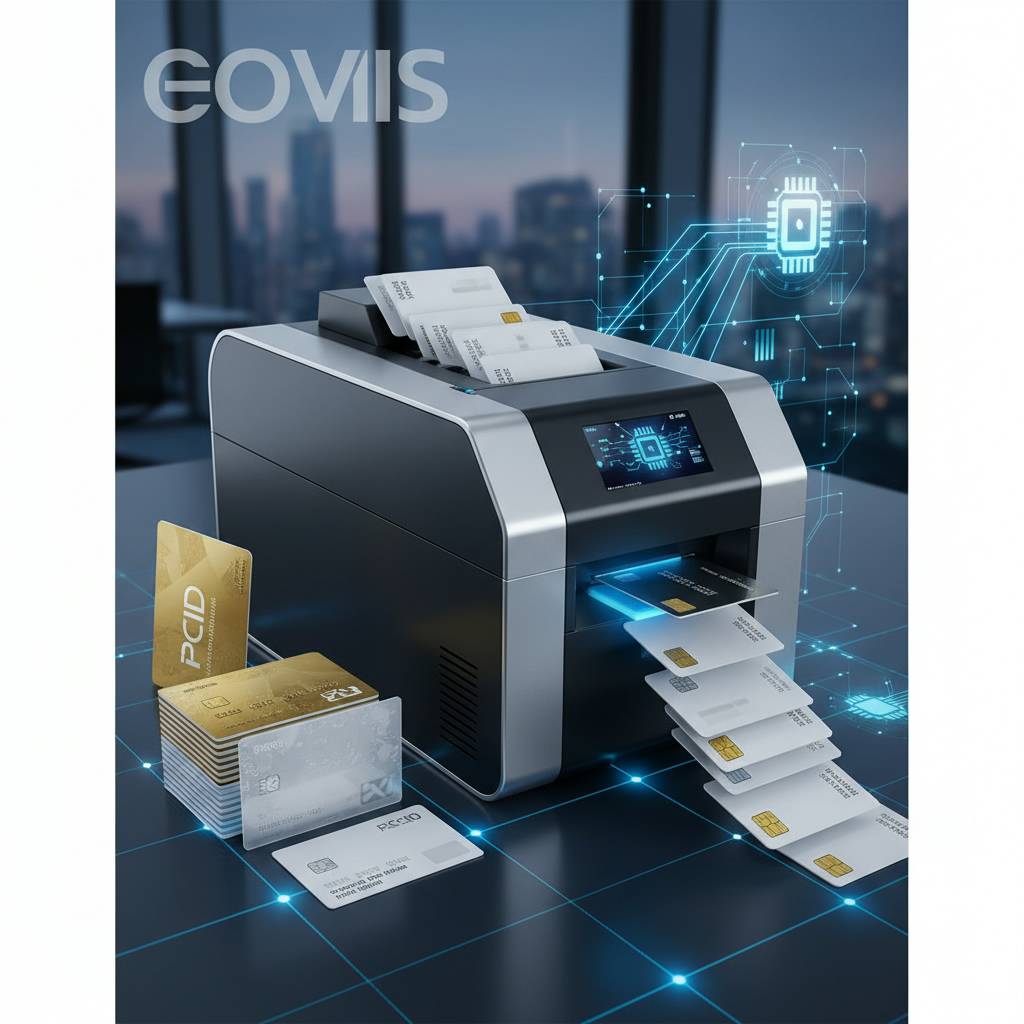 Not all smart chip encoding setups are created equal, and picking the wrong configuration can mean buying hardware twice. The variables that matter most are encoding standard (contact vs. contactless vs. dual-interface), print volume, card design complexity, and whether you need magnetic stripe encoding alongside chip encoding. Understanding these distinctions upfront saves real money and serious headaches.
The smartest buyers start with the end card in mind - what does this card need to do on day one, and what might it need to do in two years? A printer platform that accepts modular encoding upgrades protects your investment far better than a locked-down unit with no expansion path.
Contact Smart Chip Encoding
Contact encoding requires the card to be physically inserted into a chip reader, where electrical contacts on the card's surface communicate with the reader's terminals. This is the ISO 7816 standard - the same technology found in bank cards and government ID documents. It offers robust security and is widely supported by access control and logical security systems worldwide.
Printers like the Evolis Zenius and Primacy2 can be configured with a contact encoding module, writing data to the chip during the print cycle itself. This integrated workflow means a fully personalized, chip-encoded card comes out of the printer ready to activate - no secondary encoding station required.
Contactless and RFID Smart Chip Encoding
Contactless cards use embedded antenna coils to communicate via radio frequency - typically at 13.56 MHz for modern HF RFID systems like MIFARE, DESFire, or HID iCLASS. The holder taps or waves the card near a reader, and the transaction completes in under a second. For high-traffic entry points, cafeteria payment systems, or transit applications, the speed advantage is significant.
Encoding a contactless card through a printer-integrated RFID module is just as seamless as contact encoding. The printer positions the card over the encoding antenna, writes the data, then continues the print cycle. CPE can walk you through which RFID standard aligns with your existing reader infrastructure - because a beautifully printed card encoded to the wrong frequency is just a very pretty coaster.
Dual-Interface Cards and Combined Encoding Options
Dual-interface cards contain both a contact chip and a contactless antenna, connected internally. A single card can function at both types of readers - insert it into a secure workstation, or tap it at a door panel. This flexibility makes dual-interface cards the premium choice for enterprise environments where multiple authentication methods coexist.
The Evolis Primacy2 and Agilia, along with select Fargo and Zebra configurations, support dual-interface encoding natively or through upgrade modules. When your access control, HR, and IT security teams all need to interact with the same card, dual-interface encoding is the bridge that makes that possible without issuing multiple credentials per employee.
Combining Smart Chip and Magnetic Stripe Encoding
Some programs require both technologies on a single card. A hotel key card might use a magnetic stripe for legacy room locks while an RFID chip handles spa access and loyalty program check-ins. A corporate badge might use a contact chip for IT authentication and a magnetic stripe for a parking system that hasn't yet upgraded to chip readers.
Most mid-to-high range printers in Plastic Card ID's lineup support combined magnetic stripe and smart chip encoding modules. The Evolis Primacy2, Fargo, and Zebra platforms all offer this dual-encoding configuration. This kind of layered credential capability is exactly why choosing a printer with a clear upgrade path matters so much from day one.
Printer Models Built for Smart Chip Encoding Programs
Every printer Plastic Card ID carries has been selected because it performs at a professional level - not because it fills a catalog slot. The Evolis lineup in particular has earned a strong reputation among ID program managers for reliability, print quality, and the modular architecture that makes smart chip encoding upgrades straightforward rather than painful.
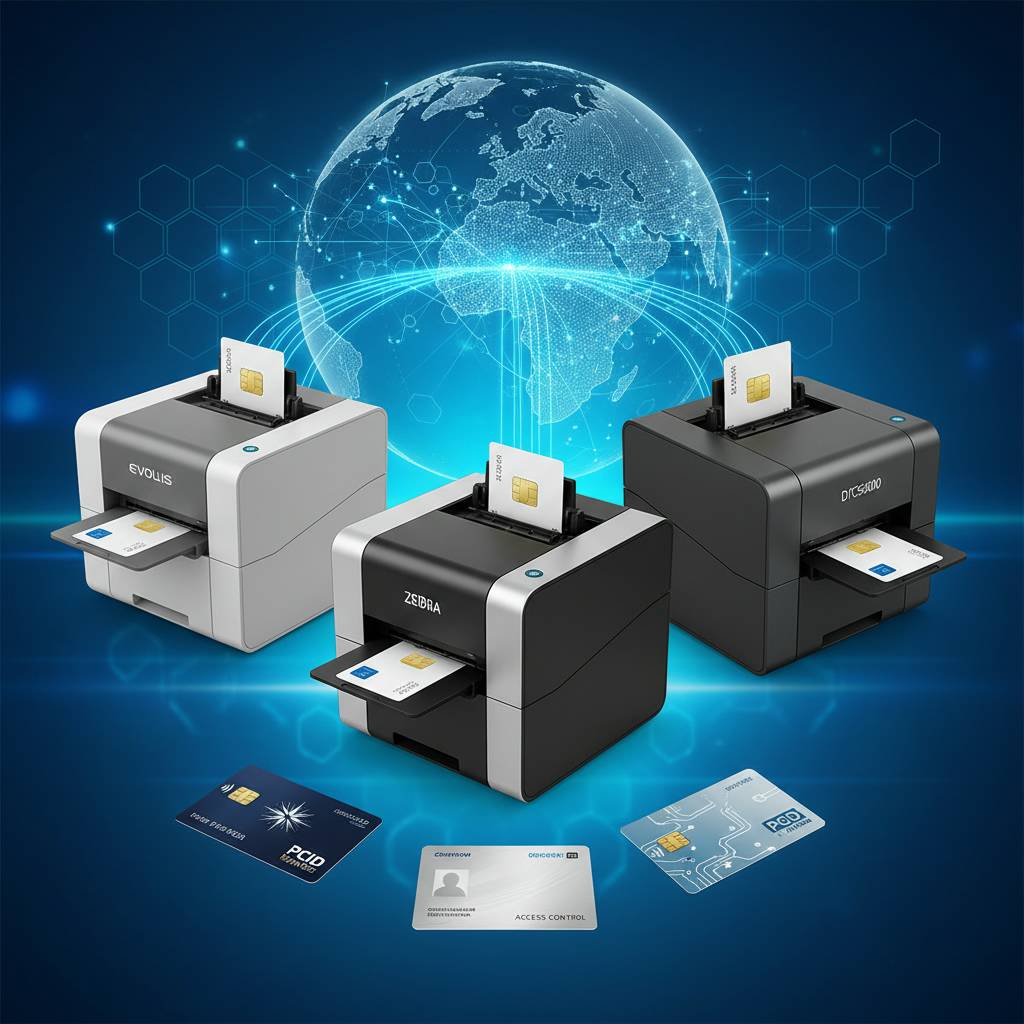
Fargo and Zebra bring their own strengths to the table, particularly for security-heavy environments where audit trails, tamper-evident overlaminates, and high-definition printing combine with chip encoding to produce truly secure credentials. Each brand serves a specific segment of the market, and CPE stocks them all.
Evolis Zenius and Primacy2: The Mid-Range Workhorses
The Evolis Zenius is a compact, single-sided printer that handles 1,000 to 6,000 cards per month with quiet reliability. Its retransfer printing technology produces sharp, vivid output, and the optional contact or contactless encoding modules bolt on cleanly without disrupting the printer's compact form factor. It's a favorite among HR departments and membership organizations that need consistent, professional results without a large equipment footprint.
The Primacy2 steps up to dual-sided printing while maintaining the same encoder-upgrade architecture. For organizations issuing cards with information on both sides and smart chip credentials embedded, the Primacy2 delivers in a single pass - no flipping, no secondary encoding step. It's the model most buyers in the 1,000-6,000 cards-per-month range end up choosing when chip encoding is on the requirements list.
Evolis Agilia: Premium Output for Demanding Programs
The Agilia is Evolis's flagship direct-to-card printer, designed for organizations that won't accept anything less than edge-to-edge, photographic-quality output. Government agencies, financial institutions, and large universities gravitate toward it - not just for print quality, but for the full encoding suite it supports. Contact, contactless, dual-interface, magnetic stripe: the Agilia handles the complete credential package.
High throughput, robust build quality, and a software ecosystem that integrates with enterprise card management platforms make the Agilia the natural selection when a card program has grown beyond what mid-range hardware can sustain. When your credential program is mission-critical, the Agilia is the machine that earns its place in the infrastructure.
Fargo and Zebra: Security-First ID Programs
Fargo printers - particularly the HDP series - use a retransfer process that prints to a film before applying it to the card, producing output that is sharper, more durable, and more resistant to tampering than direct-to-card alternatives. When combined with smart chip encoding modules and high-definition color printing, Fargo printers produce credentials that are genuinely difficult to counterfeit.
Zebra card printers bring similar security capabilities with a slightly different software and hardware ecosystem - one that integrates naturally with Zebra's broader enterprise mobility and labeling platforms. For organizations already using Zebra infrastructure, extending it into card printing with smart chip encoding is a logical, low-friction upgrade. Call 800.835.7919 to discuss which Fargo or Zebra configuration fits your specific security profile.
Supplies and Accessories That Keep Your Card Program Running
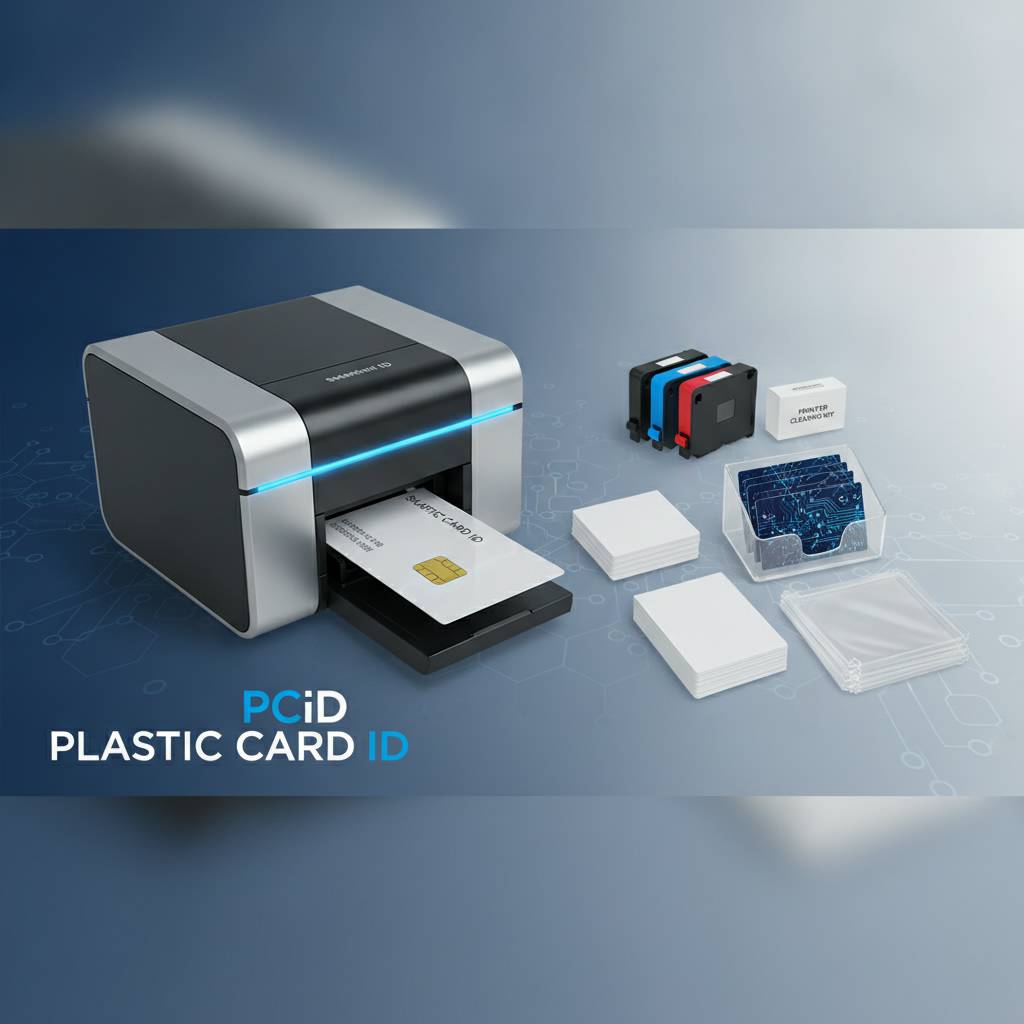 A printer is only as good as the consumables feeding it. Ribbon quality affects color accuracy and durability. Cleaning kits prevent encoder errors that corrupt chip data. Lamination modules add a layer of physical protection that extends card life significantly. Plastic Card ID supplies everything downstream from the printer itself, ensuring your card program doesn't stall mid-run because of a supply chain gap.
This matters more than many buyers anticipate at purchase time. A smart chip encoding program produces cards that represent real investments in credential infrastructure - and a degraded ribbon or dirty encoding head can waste that investment one misprinted card at a time.
Ribbons: YMCKO, Monochrome, and Specialty
Full-color YMCKO ribbons (Yellow, Magenta, Cyan, Black, and Overlay) are the workhorses of color card printing - the overlay panel adds a protective coating that resists scratching and fading. Monochrome ribbons print single-color text and barcodes at higher speeds and lower per-card cost, making them ideal for batch encoding runs where color isn't required.
Specialty ribbons add features like UV-fluorescent panels for security verification or scratch-resistant formulations for high-wear applications. Matching the right ribbon to the right application is one of the most impactful cost-per-card decisions a card program manager can make - and CPE carries the full range to cover every use case.
Cleaning Kits and Encoder Maintenance
Smart chip encoding modules are precision components. Dust, debris, and card residue accumulate on encoding contacts and antenna positions over time, causing write errors that corrupt chip data or fail silently - meaning a card prints beautifully but encodes nothing. Regular cleaning with manufacturer-approved cleaning cards and swabs prevents these failures before they compound into larger problems.
Plastic Card ID stocks cleaning kits calibrated for Evolis, Fargo, Zebra, and Matica printers. Running a cleaning cycle on a scheduled basis - typically every 500-1,000 cards, depending on environment - is one of the simplest ways to protect encoder longevity and maintain the data integrity of every card your program produces.
Lamination Modules, Hoppers, and Card Carriers
Lamination modules apply a clear or holographic overlay to the finished card, dramatically increasing resistance to wear, UV exposure, and tampering attempts. For access cards that transit pockets and wallets dozens of times per day, lamination is a practical upgrade that extends card life from months to years. Several Evolis and Fargo models support inline lamination as an add-on module.
Input hoppers extend print run capacity - essential for batch encoding jobs where refilling the card tray every 100 cards is genuinely disruptive. Card carriers and sleeves provide a professional presentation format for issued credentials while protecting the chip surface from contact damage. These aren't afterthoughts; a well-stocked card program supply shelf is what separates a smooth operation from a frustrating one.
Buyer's Guide: Choosing the Right Smart Chip Encoding Printer
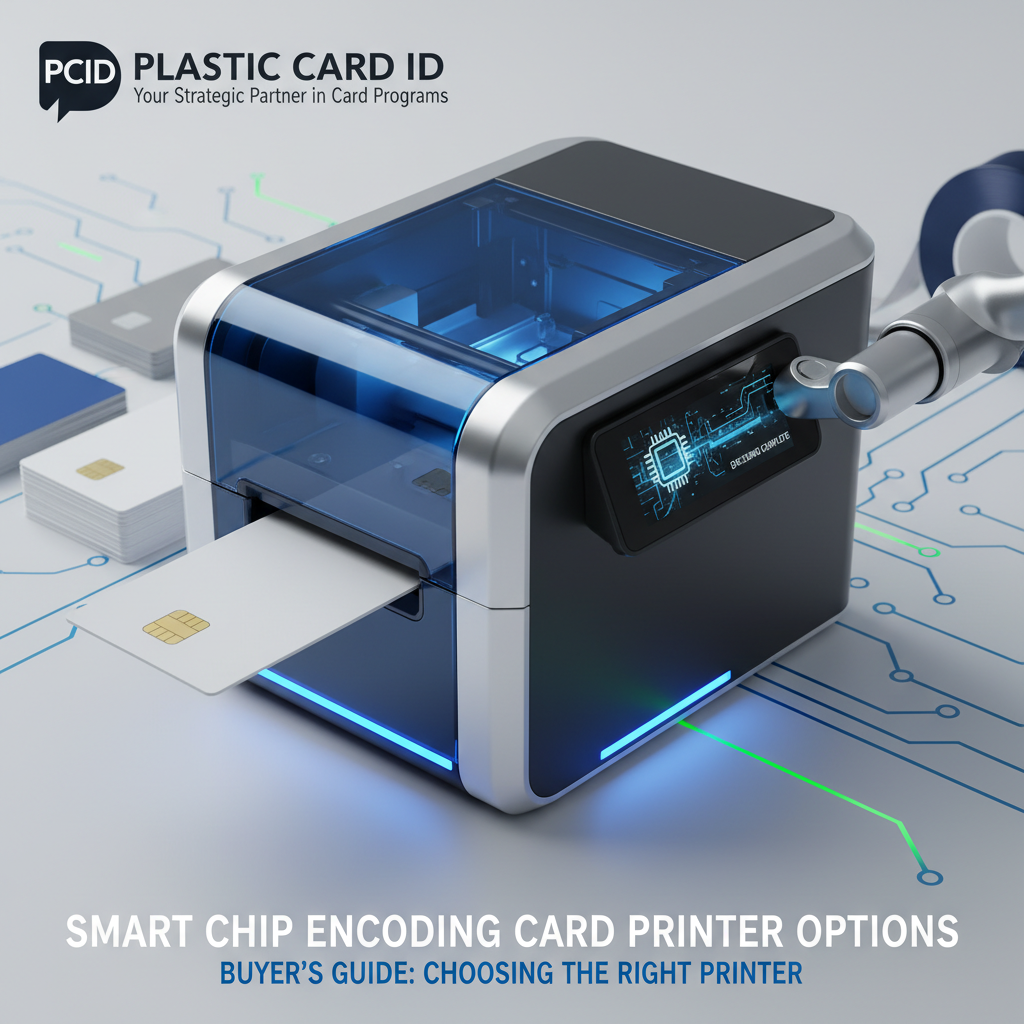 Matching a printer to a smart chip encoding program requires honest answers to a short list of questions - and most buyers get into trouble by skipping one or two of them. Volume, encoding standard, card design complexity, and budget all interact in ways that aren't always obvious from a spec sheet. The following framework helps cut through the noise.
- Annual card volume: Under 1,000 cards/year points toward entry-level models like the Evolis Badgy200. Between 1,000 and 6,000 cards/month suggests the Zenius or Primacy2. Higher volumes point toward the Agilia or commercial-grade Fargo and Zebra platforms.
- Encoding standard required: Confirm which chip technology your reader infrastructure supports before selecting a module. MIFARE Classic, DESFire, HID iCLASS, and ISO 7816 contact chips all require different encoding configurations.
- Single-sided vs. dual-sided: If your card design requires printing on both sides, the Primacy2 or dual-sided Fargo and Zebra models are necessary - the Zenius and Badgy200 are single-sided only.
- Magnetic stripe requirements: If legacy systems in your environment require a magnetic stripe alongside the chip, specify a combined encoder at purchase time - retrofitting later is possible but more expensive.
- Lamination needs: High-wear environments benefit significantly from inline lamination modules. Factor this into the total system cost from the start.
- Software integration: Enterprise card management platforms have varying levels of driver support for different printer brands. Confirm compatibility before committing to a platform.
Common Mistakes and How to Avoid Them
The most common mistake buyers make is underestimating volume. A printer rated for 1,000 cards per year being pushed to print 4,000 will wear out faster, require more frequent maintenance, and ultimately cost more per card over its lifecycle than a properly sized mid-range machine would have from the start. Buying to your current volume plus 30% growth headroom is almost always the financially sound choice.
The second most common mistake is ignoring encoding module compatibility with existing reader hardware. A card printer is only one half of a smart card system - the reader on the other end has to speak the same protocol. Confirming that alignment before purchase avoids the frustrating scenario of a beautifully equipped printer producing cards that work nowhere in your facility.
Questions to Ask Before You Buy
Beyond the framework above, a few targeted questions help sharpen the decision. Does your access control system vendor have a preferred card technology they support best? Does your IT security team have a FIPS or other compliance requirement for chip encryption? Will multiple departments be sharing the printer, and if so, does the software support multi-user job queues?
CPE is equipped to work through these questions with buyers directly. The goal isn't to sell the most expensive printer in the catalog - it's to match the right hardware to the program's real requirements, so the system works correctly from the first card to the ten-thousandth.
Frequently Asked Questions About Smart Chip Encoding Card Printers
After years of supporting card programs across virtually every industry, certain questions come up repeatedly. The answers below reflect real-world use cases and the nuances that generic spec comparisons tend to flatten out.
Can I add smart chip encoding to a printer I already own?
In many cases, yes - provided the printer was designed to accept encoding modules. Evolis printers in particular are built with this expandability in mind; a Primacy2 or Zenius purchased without an encoding module can often be upgraded later. That said, not all models support post-purchase upgrades, and the upgrade process varies by brand.
If you're considering an existing printer for encoding expansion, contact Plastic Card ID at 800.835.7919 with the model number and purchase date. The team can confirm whether an encoding module is available for your specific unit and what the upgrade path looks like in terms of cost and installation.
What's the difference between HF RFID and LF RFID for card encoding?
Low-frequency (LF) RFID typically operates at 125 kHz and is used in older proximity card systems - the kind that dominated access control installations in the 1990s and 2000s. High-frequency (HF) RFID operates at 13.56 MHz and supports modern standards like MIFARE, DESFire, and NFC. HF systems offer significantly more data capacity and stronger encryption options compared to legacy LF systems.
Most current smart chip encoding printer modules support HF 13.56 MHz standards. If your facility still runs a legacy 125 kHz system, the card printing investment may be an opportunity to evaluate upgrading the reader infrastructure as well - a conversation worth having with your access control vendor before purchasing encoding hardware.
How many cards can I print per ribbon panel?
A standard YMCKO ribbon panel yields approximately one full-color card per panel set. Ribbon panel counts per roll vary by manufacturer and printer model - typically ranging from 100 to 500 prints per roll for full-color ribbons, with monochrome rolls extending considerably further. Cost per card for ribbon consumption generally runs between $0.50 and $2.00 depending on ribbon type and volume.
Buying ribbons in larger quantities reduces the per-print cost and minimizes the frequency of consumable resupply. Plastic Card ID stocks ribbons for all supported printer brands, and CPE can help calculate the right ribbon stocking levels for your program's print schedule to avoid operational interruptions.
Ready to Build Your Smart Card Program With Plastic Card ID?
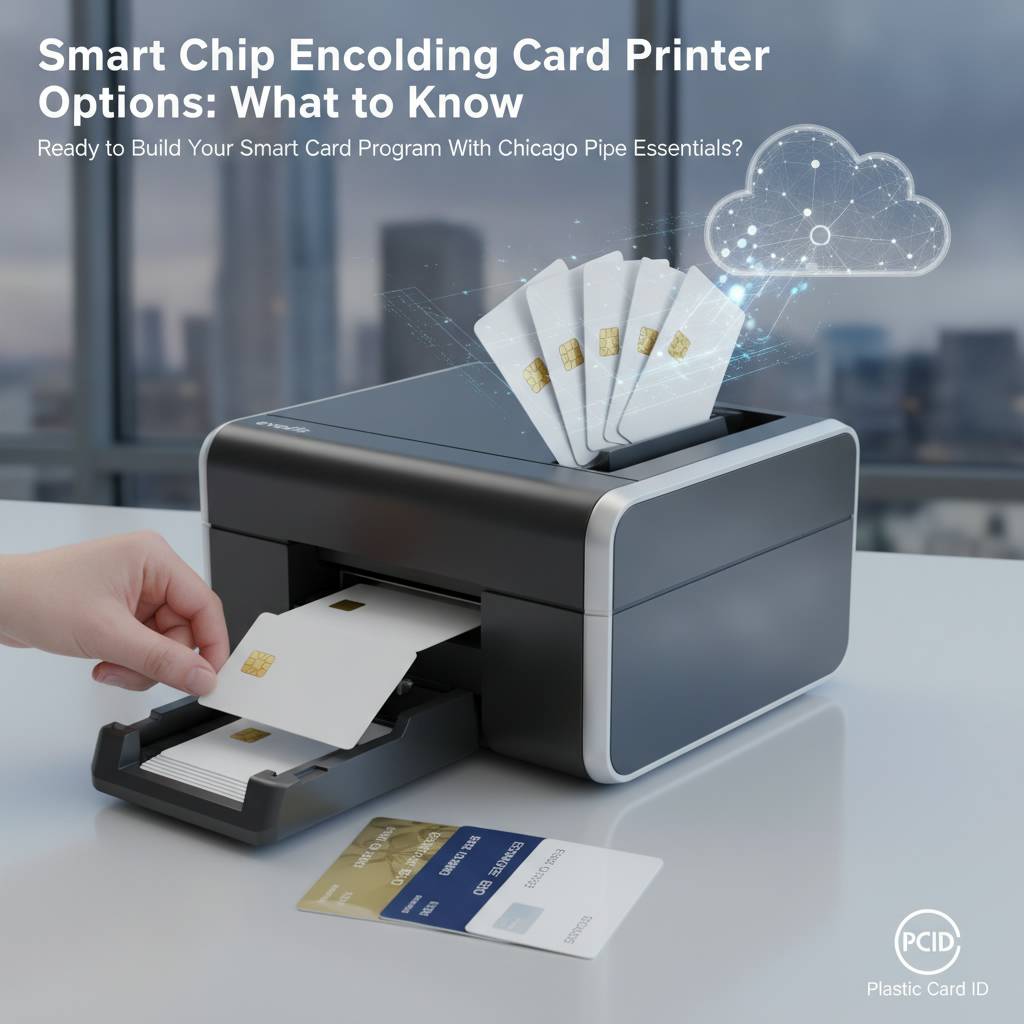 A smart chip encoding card printer program isn't just a hardware purchase - it's an infrastructure decision that affects security, operations, and day-to-day workflow for years. The right printer, correctly specified and properly supplied, runs quietly in the background while your team focuses on the work that actually matters. The wrong one creates friction at every step.
Plastic Card ID has spent over 25 years helping organizations get this decision right, serving more than 100,000 customers across the United States with professional-grade card printing hardware from Evolis, Fargo, Zebra, and Matica. Every encoder module, ribbon type, cleaning kit, and accessory needed to run a complete smart card program is available through a single, experienced source.
What to Expect When You Contact the Team
When you reach out, you're not entering a sales funnel - you're starting a practical conversation. The team at CPE will ask about your volume, your reader infrastructure, your card design requirements, and your budget. From there, they'll narrow the options to what actually fits rather than presenting an overwhelming catalog and leaving the decision entirely to you.
Buyers who have gone through this process consistently describe it as refreshingly straightforward. No upselling into hardware that exceeds what the program needs, and no underselling into equipment that will be outgrown in six months. Just an honest assessment and a clear path to the right solution.
Get Started Today
Ready to explore your smart chip encoding card printer options? Contact Plastic Card ID at 800.835.7919 and speak with a card printing specialist who can guide you to the right hardware, accessories, and consumables for your specific program - whether you're starting from scratch or upgrading an existing setup.
Plastic Card ID - your trusted partner for professional plastic card printer solutions. Call 800.835.7919 today and put 25 years of card printing expertise to work for your organization.
Magnetic Stripe Card Encoding Guide for ID Card Printers
Previous Page