Entry-Level vs High-Volume Card Printers: Which to Choose
Table of Contents []
- Choosing the Right Card Printer: Plastic Card ID Breaks Down Entry-Level vs High-Volume Options
- What Entry-Level Card Printers Actually Do Well
- Mid-Range Printers: Where Capability Meets Everyday Production
- High-Volume and Industrial Card Printers: Built for Serious Scale
- The Real Case for In-House Card Printing
- Buyer's Guide: Matching the Right Printer to Your Needs
- Get Started with Plastic Card ID Today
Choosing the Right Card Printer: Plastic Card ID Breaks Down Entry-Level vs High-Volume Options
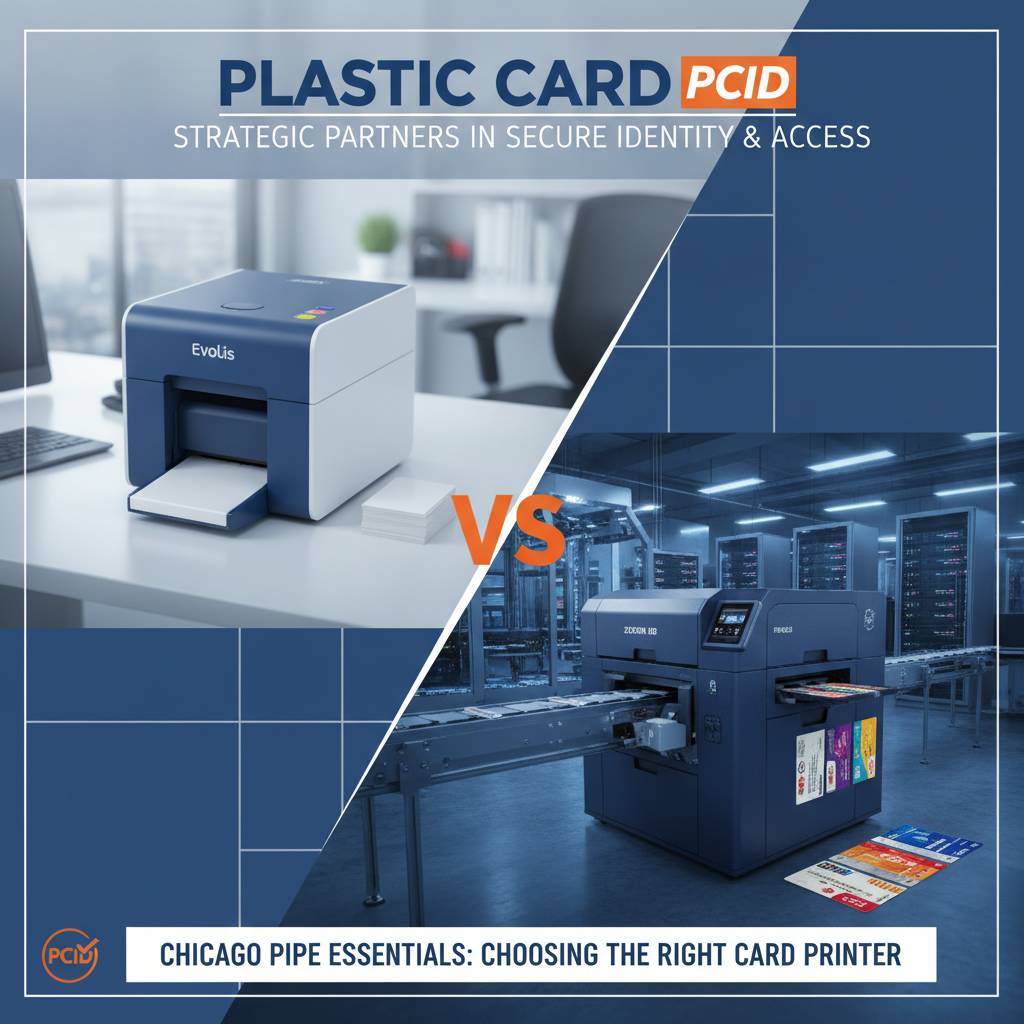 Not every organization printing plastic cards has the same needs - and that gap matters more than most buyers realize when they start shopping. A school printing student IDs twice a year has almost nothing in common with a hotel chain issuing key cards around the clock. The difference between the right printer and the wrong one isn't just price - it's operational fit. Get it wrong and you're either overspending on capability you'll never use, or grinding a light-duty desktop unit into an early grave.
That's where Plastic Card ID comes in. With more than 25 years of experience supplying plastic card printers to over 100,000 businesses across the United States, CPE has seen every type of card program imaginable - from single-location nonprofits printing a few hundred member cards annually to enterprise operations running multi-shift, high-volume ID issuance programs. The knowledge that comes from serving that range of customers is hard to overstate.
This guide cuts through the noise. Whether you're a first-time buyer trying to understand what "YMCKO ribbon" even means, or a seasoned IT manager upgrading aging equipment, the information here is built to help you make a confident, well-matched purchasing decision.
| Category | Entry-Level | Mid-Range | High-Volume |
|---|---|---|---|
| Annual Volume | Under 1,000 cards/year | 1,000-6,000 cards/month | 6,000 cards/month |
| Example Models | Evolis Badgy200 | Evolis Zenius, Primacy2 | Evolis Agilia, Matica Event |
| Dual-Sided Printing | Optional/Limited | Available | Standard |
| Encoding Options | Basic | Mag stripe, Smart chip | Full encoding suite |
| Lamination Module | Not available | Select models | Available |
| Ideal Use Case | Small orgs, occasional use | Regular daily printing | Enterprise, events, hotels |
What Entry-Level Card Printers Actually Do Well
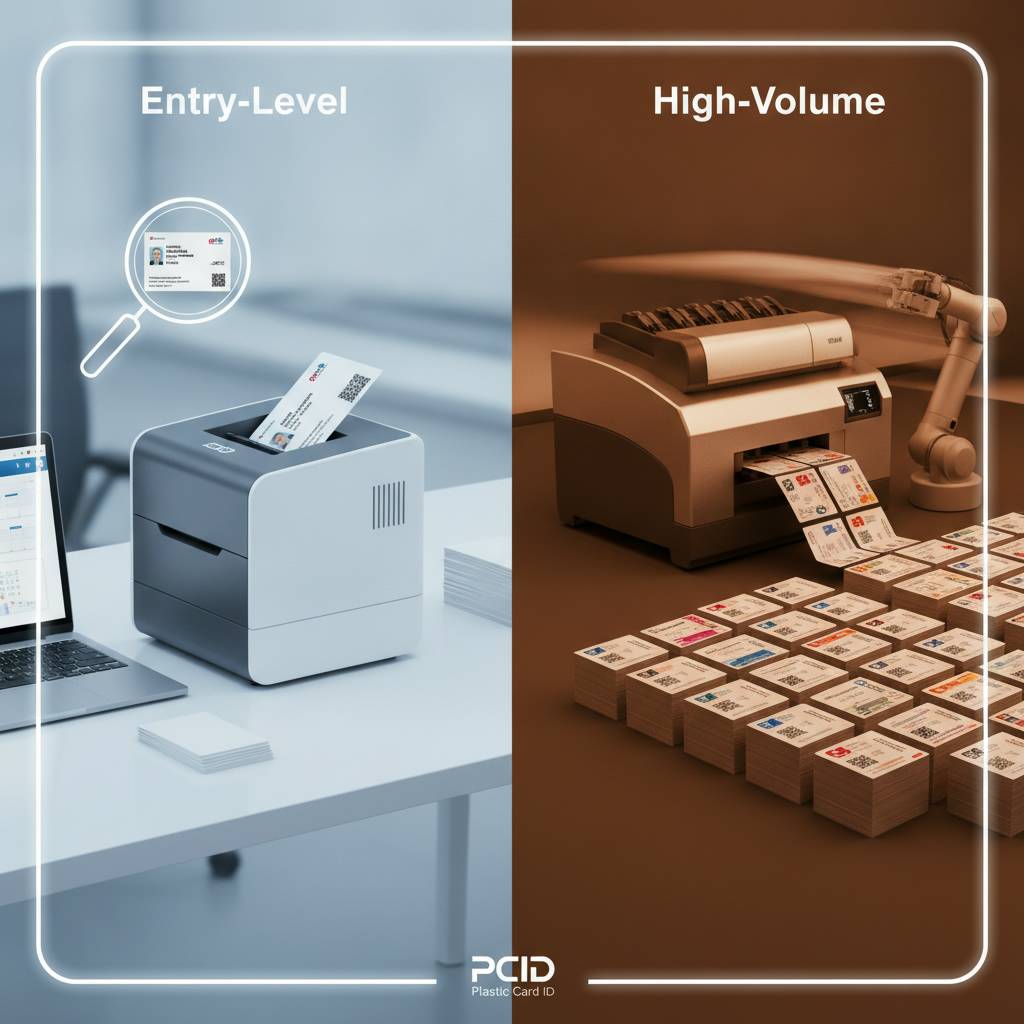 There's a temptation to treat "entry-level" as a polite way of saying "inferior." That's a mistake. Entry-level card printers are precision-engineered tools designed for a specific operational envelope - and inside that envelope, they deliver genuinely impressive results. The Evolis Badgy200 is the defining example of this category: a compact, single-sided desktop unit capable of producing full-color, professional-quality ID cards for organizations printing fewer than 1,000 cards per year.
For a small business issuing employee badges, a community center managing membership cards, or a regional school district handling student IDs at a single campus, the Badgy200 hits every mark. Setup is straightforward, the learning curve is manageable for non-technical staff, and the per-card output quality matches what you'd expect from a dedicated card production operation. The printer connects via USB, works with standard CR80 cards, and uses the YMCKO ribbon format to deliver vibrant, full-color prints.
The Evolis Badgy200: A Closer Look
The Badgy200 occupies a sweet spot that's easy to underestimate. It's priced accessibly relative to higher-tier machines, yet it doesn't sacrifice print resolution - cards come out looking sharp, professional, and durable. For organizations that print in batches rather than continuously, this printer handles the occasional surge without complaint.
What makes the Badgy200 particularly practical is its bundled software. Evolis includes card design tools that let even first-time operators create polished layouts without any graphic design background. Templates, drag-and-drop fields, and database connectivity for personalization are all part of the package. That out-of-the-box readiness is genuinely valuable when you don't have dedicated IT support standing by.
Ribbons and Consumables for Entry-Level Units
Every entry-level printer's total cost of ownership depends heavily on consumables. Plastic Card ID supplies the full range of Evolis-compatible ribbons including YMCKO (full color with clear overlay), monochrome ribbons in black or single-color formats, and cleaning kits that keep print heads performing optimally over the printer's service life.
YMCKO ribbons are the standard choice for full-color card printing - the Y, M, and C panels deliver the color image, while the K panel adds a black resin layer for sharp text and barcodes, and the O panel applies a protective clear overlay. Using the correct ribbon for your card type isn't optional - it directly affects card durability and print quality. CPE stocks these consumables consistently, so you're never left scrambling mid-run.
Who Should Buy Entry-Level and When to Reconsider
The decision to go entry-level should be grounded in honest volume assessment. If your organization prints fewer than 80-100 cards per month on average, an entry-level unit is the smart, cost-effective call. Nonprofits, small retail businesses, clinics, and small educational institutions typically fall into this category comfortably.
However, if you're already stretching that volume ceiling - or anticipating significant growth within the next 12-18 months - the calculus shifts. Running a printer beyond its intended duty cycle shortens its lifespan, increases maintenance frequency, and ultimately costs more than simply buying the right-sized unit from the start. Honest volume forecasting before purchase saves real money down the line.
Mid-Range Printers: Where Capability Meets Everyday Production
Step up to the mid-range tier and the operational picture changes substantially. Printers like the Evolis Zenius and Evolis Primacy2 are built for organizations that need reliable, daily card production - teams where the printer runs every business day and card quality directly affects how employees, members, or customers perceive the organization. These units handle 1,000 to 6,000 cards per month with consistency that entry-level hardware simply cannot match at that pace.
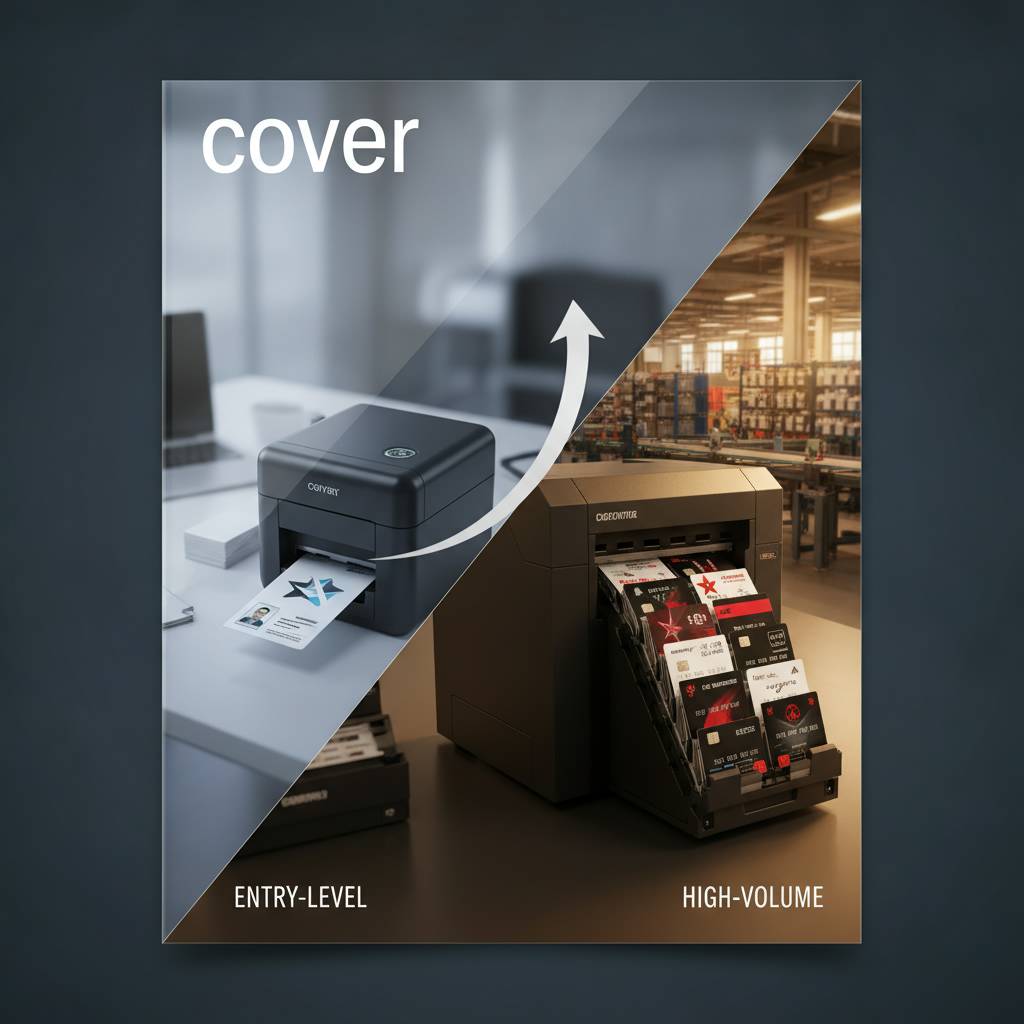
The Primacy2 in particular represents a mature engineering evolution. It supports both single- and dual-sided printing, integrates optional encoding modules for magnetic stripe and smart chip, and offers lamination module compatibility for cards that require extra durability. For an HR department issuing access control badges, a hospital managing staff credentials, or a university handling student IDs at scale, the Primacy2 delivers without drama.
Evolis Zenius: The Compact Workhorse
The Zenius is the smaller sibling in the mid-range family - and it earns its place by being efficient without being limited. Single-sided printing at volume, clean USB and Ethernet connectivity, and compatibility with the full range of Evolis ribbons and cleaning kits make it a practical daily driver for medium-sized operations. It's also one of the more straightforward printers to maintain, which matters when the person running it has other responsibilities.
Organizations that prize simplicity and reliability over feature density will find the Zenius hard to beat. A retail chain managing loyalty card issuance across regional locations, for example, can deploy Zenius units at individual stores with minimal training overhead and consistent output quality across every site.
Evolis Primacy2: Dual-Sided and Encoder-Ready
The Primacy2 steps into dual-sided territory with a built-in card flipper that keeps throughput high even when printing both card faces. Magnetic stripe encoding - critical for access control, hotel key cards, and loyalty programs using swipe-based infrastructure - is an available module option that integrates cleanly into the print-and-encode workflow. Smart chip encoding adds another layer of functionality for organizations using contact chip cards.
What CPE finds with mid-range buyers is that the Primacy2 frequently becomes the long-term anchor printer for growing organizations. It's bought as a step up from entry-level and often runs for years without needing replacement, because its duty cycle is aligned to realistic professional use. That longevity makes the Primacy2 one of the best total-value propositions in the entire lineup.
Fargo and Zebra Options at the Mid-to-Upper Range
Fargo and Zebra printers bring a different engineering philosophy to the mid-range and upper-mid segments - one particularly well suited to security-focused ID programs. Government agencies, financial institutions, healthcare networks, and enterprises with strict access control standards often gravitate toward these brands because of their established reputation in credentialing environments where tamper-evidence and card integrity are non-negotiable requirements.
Call Plastic Card ID at 800.835.7919 to discuss which Fargo or Zebra model aligns with your security and encoding requirements. The product lineup spans multiple configurations, and the right choice depends on your volume, dual-sided needs, and encoding specifications. Getting that match right the first time avoids costly hardware changes later.
High-Volume and Industrial Card Printers: Built for Serious Scale
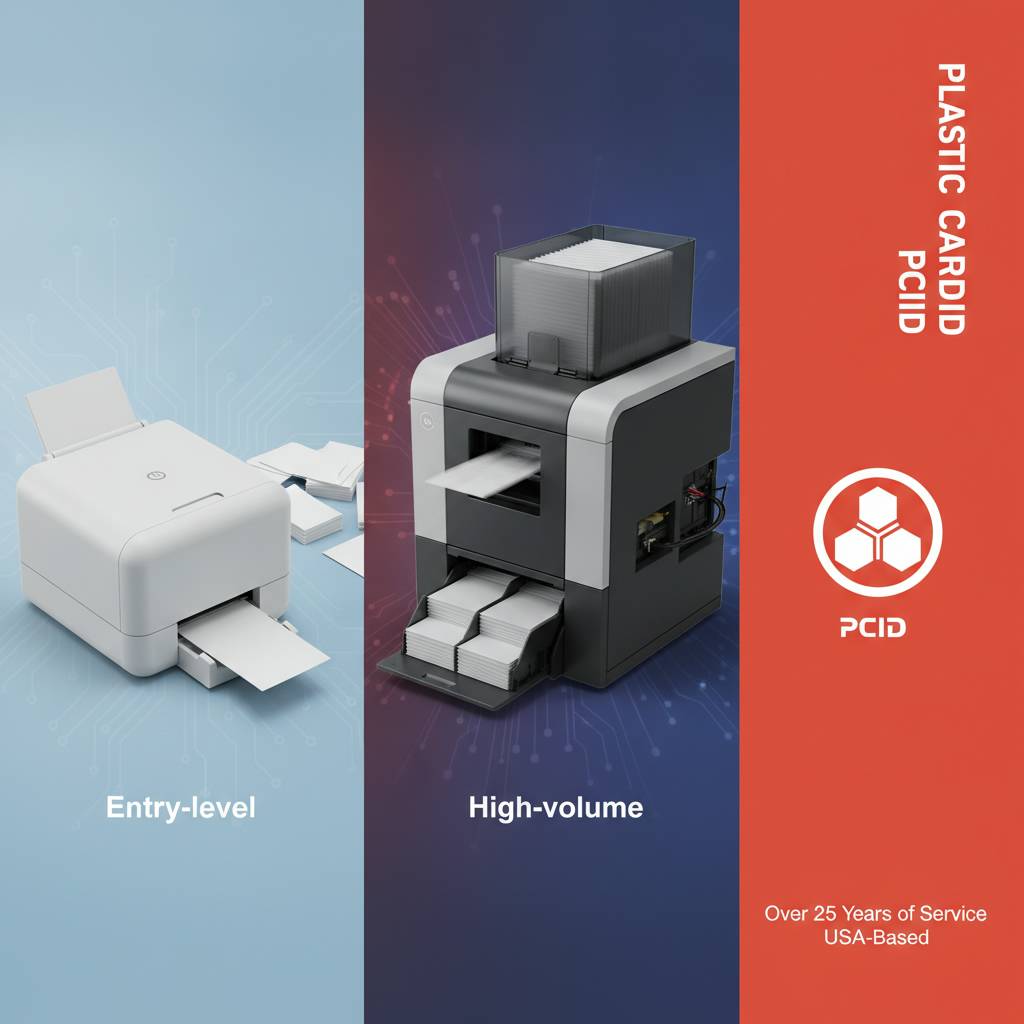 Some operations don't just print cards - they produce them in quantities that would overwhelm a standard desktop unit within a week. Hotel chains managing key card logistics across dozens of properties, corporate campuses issuing credentials to thousands of employees, event venues processing attendee badges for large conferences - these environments need industrial-grade hardware that treats high throughput as a baseline expectation, not an exceptional demand.
The Evolis Agilia sits at the top of the performance tier for organizations demanding edge-to-edge, highest-quality output with industrial reliability. This printer is engineered for operations where print quality cannot vary, production pace must remain consistent across extended runs, and downtime is simply not an acceptable outcome. When professional image and uninterrupted production are both mandatory, the Agilia delivers.
Evolis Agilia: Premium Output at Scale
Edge-to-edge printing - the ability to cover the full card surface without any white border - transforms the visual impact of a plastic card dramatically. The Agilia achieves this with a level of color consistency and image sharpness that positions every card it produces as a premium credential rather than a functional commodity. For organizations where the card itself is part of brand presentation, that distinction matters.
Beyond print quality, the Agilia supports the full encoding suite: magnetic stripe, smart chip, and contactless chip encoding configurations are all available. Input hoppers, card carriers, and lamination modules round out the production-line capability. Organizations that have outgrown mid-range hardware and need to consolidate card production under one reliable roof will find the Agilia meets that brief convincingly.
Matica Event Printer: High-Speed On-Site Badging
The Matica Event Printer addresses a very specific but demanding use case: on-site badge printing at events where speed and volume arrive simultaneously. Conferences, trade shows, corporate events, and large-scale training sessions all share the same challenge - hundreds or thousands of attendees need personalized badges produced quickly, on location, without a queue that frustrates the very people you're trying to impress.
The Matica Event Printer is engineered specifically for that high-pressure, high-throughput scenario. Fast print cycles, robust build quality suitable for event environments, and the capacity to handle rapid sequential personalization make it the tool of choice for event credentialing professionals. When the doors open and the crowd arrives, this printer keeps pace.
Input Hoppers and High-Volume Accessories
Plastic Card ID supplies the accessories that turn a capable printer into a fully operational production station. High-capacity input hoppers dramatically reduce the frequency of manual card loading during large runs - an important quality-of-life feature when a single production session might involve thousands of cards. Output hoppers and card carriers maintain finished card organization and protect surfaces from handling damage.
- High-capacity input hoppers - reduce manual reloading during extended production runs
- Lamination modules - add a durable protective overlay layer to finished cards
- Magnetic stripe encoding modules - write track data during the print cycle
- Smart chip encoding modules - contact chip programming integrated into production workflow
- Card carriers and sleeves - protect finished credentials during transport and storage
- Cleaning kits - maintain print head performance and extend hardware service life
Building a complete card production station from a single supplier simplifies procurement, ensures component compatibility, and gives your team one point of contact for support. That operational simplicity is one of the reasons CPE has maintained customer relationships spanning decades.
The Real Case for In-House Card Printing
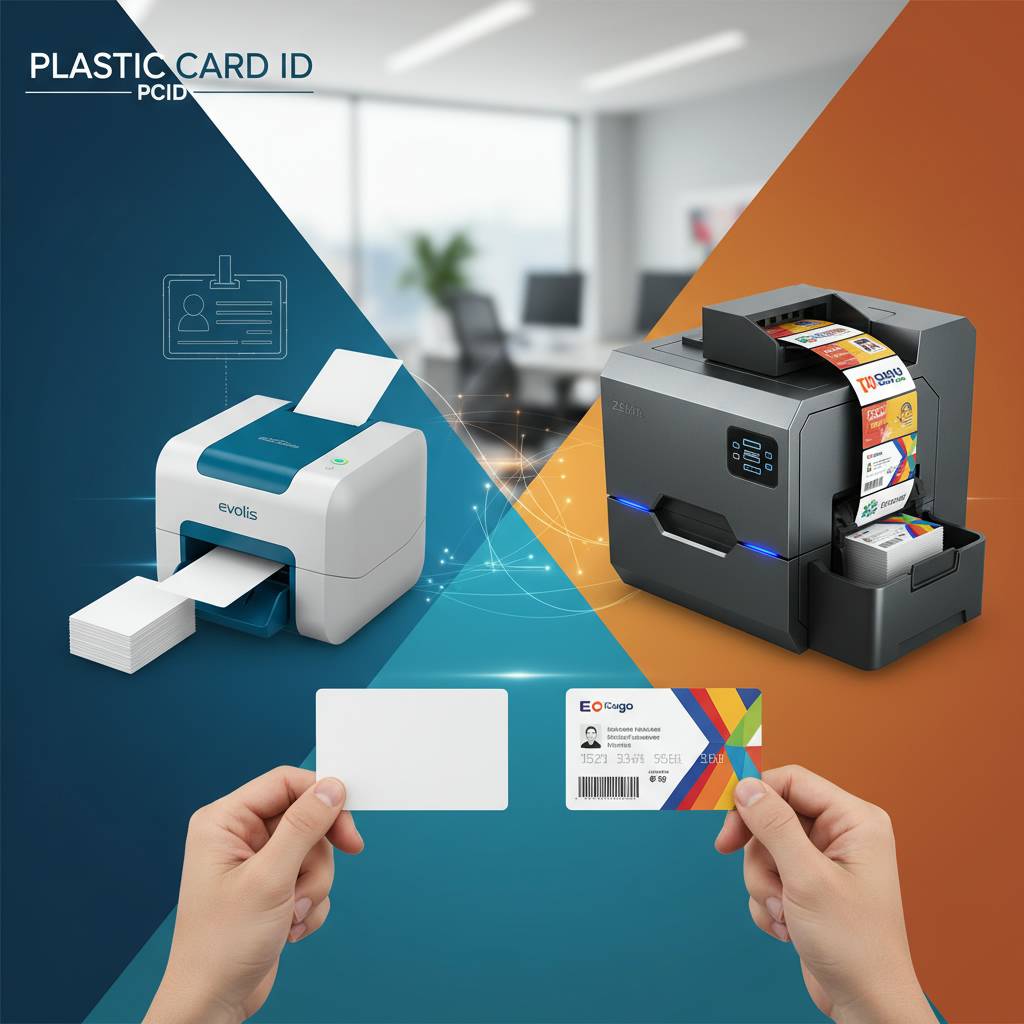 Organizations that have only ever ordered cards from an outside vendor sometimes struggle to see why in-house printing would be worth the investment. The outsourced model feels familiar - you submit artwork, wait a few weeks, receive cards in bulk. But that model carries hidden costs and constraints that in-house printing eliminates entirely. Control, speed, and personalization are the three pillars that make in-house printing so compelling.
Consider what on-demand printing actually means in practice: a new employee starts Monday and has a fully personalized, encoded access badge waiting at their desk. A loyalty program member signs up in-store and walks out with a card in hand. A conference attendee checks in and receives a printed, personalized badge before they've reached the coffee station. None of that is possible with a two-week vendor lead time.
Print on Demand and Personalization
Modern card printers connect directly to your database or HR system, pulling names, photos, titles, and other variable data to produce unique cards in sequence. The Evolis Primacy2, for example, handles variable data printing across dual-sided output with magnetic stripe encoding in a single pass - no post-processing, no manual assembly, no errors from batch re-keying. Personalization at that level of automation is genuinely transformative for high-turnover environments.
Retail chains, healthcare networks, and corporate campuses all share the need to issue cards quickly, accurately, and at scale. When staff turnover is regular and onboarding timelines are tight, the ability to produce a credentialed ID card in minutes rather than weeks isn't a luxury - it's an operational requirement that directly affects security and compliance posture.
Card Applications Across Industries
The breadth of card applications that Plastic Card ID supports reflects the genuine versatility of professional card printers. Employee ID cards are the most visible use case, but the application list extends substantially beyond them. Access control cards with encoded magnetic stripes or smart chips manage facility entry. Student IDs double as library cards, meal plan accounts, and transit passes. Hotel key cards integrate with property management systems. Membership and loyalty cards drive retention programs across retail and hospitality.
Each of these applications has specific technical requirements that influence printer selection. A hotel key card program needs magnetic stripe encoding; a student ID program may need dual-sided printing with a photo on front and barcode on the reverse; an access control program might require contactless smart chip encoding. Matching printer capability to application requirement is exactly where experienced guidance from CPE proves its worth.
Eliminating Vendor Lead Times and Dependency
Relying on an outside card vendor introduces a supply chain dependency that many organizations don't fully appreciate until it fails them. A batch arrives late, the artwork file was corrupted, the wrong laminate was applied - suddenly your onboarding cycle, your event schedule, or your access control rollout is delayed by factors entirely outside your control. In-house printing removes that dependency at its root.
Your production timeline becomes your own. Your card designs stay in-house and can be updated instantly - a logo change, a new security feature, a revised card layout can all be implemented without reprinting an entire vendor batch. That agility is a genuine competitive and operational advantage that compounds in value the longer the program runs.
Buyer's Guide: Matching the Right Printer to Your Needs
The single most important question to answer before purchasing a card printer is volume - specifically, how many cards will you actually print per month across a realistic operational year? Not the theoretical peak, not the ambitious growth projection, but the honest expected average. That number determines more about the right printer choice than any other single factor.
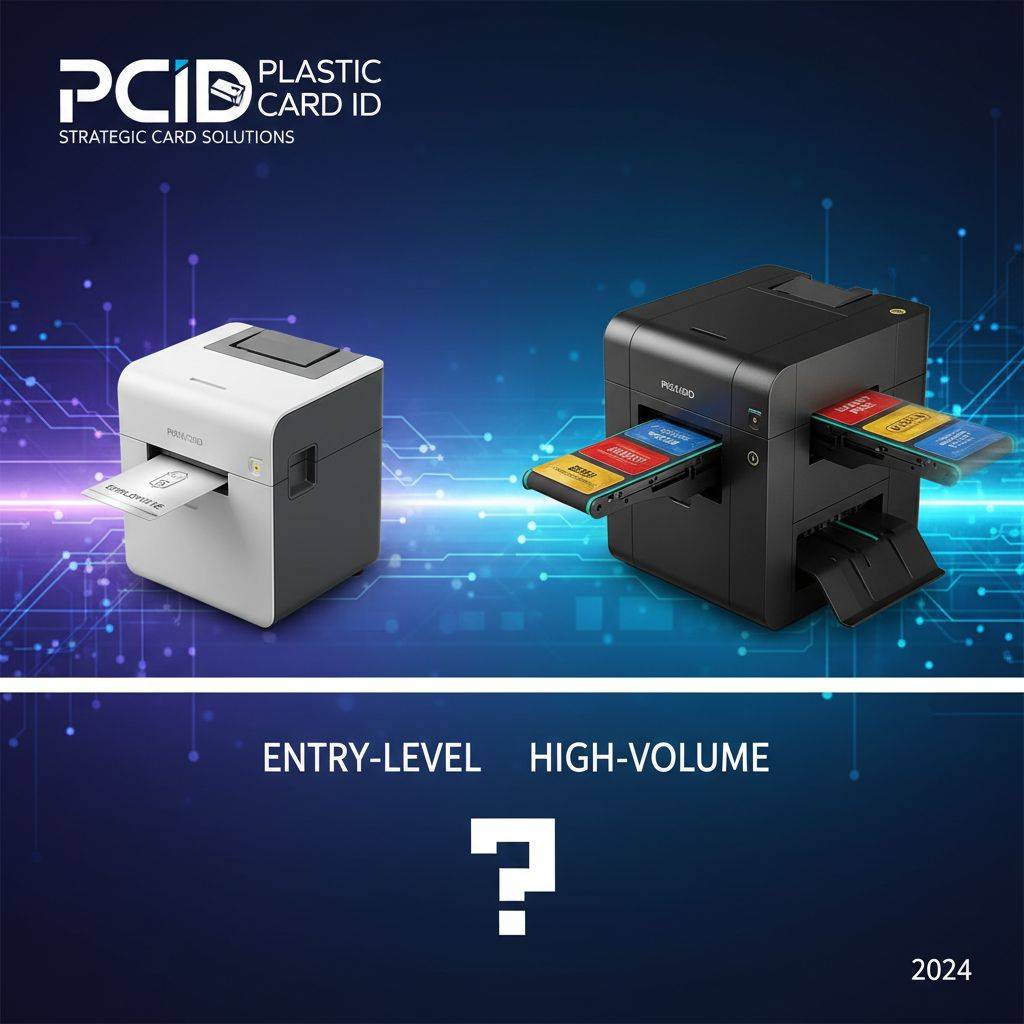
Second to volume is feature set. Do your cards need to be printed on both sides? Do they need to carry encoded data on a magnetic stripe or smart chip? Do they require a laminate overlay for extended durability? Each of these requirements narrows the field - and each adds cost, both to the hardware and the consumables. Building a clear requirements list before you start comparing models saves significant time and prevents costly mismatches.
Quick Decision Framework for Buyers
- Fewer than 1,000 cards per year, single-sided, no encoding: Evolis Badgy200
- 1,000-3,000 cards per month, single-sided, basic encoding needs: Evolis Zenius
- 1,000-6,000 cards per month, dual-sided, mag stripe or chip encoding: Evolis Primacy2
- Security-focused ID programs requiring robust credentialing infrastructure: Fargo or Zebra models
- Premium edge-to-edge output at scale, full encoding suite required: Evolis Agilia
- High-speed on-site event badging at volume: Matica Event Printer
This framework covers the majority of use cases, but real-world buying decisions often involve nuance that doesn't fit cleanly into a table. Network connectivity requirements, software integration complexity, multi-location deployment logistics, and budget constraints all interact in ways that a simple grid can't fully capture. That's why having an experienced supplier available to discuss specifics matters.
Budget Expectations Across Tiers
Entry-level printers like the Badgy200 sit at a significantly lower price point than mid-range or industrial units, reflecting their narrower operational scope. Mid-range units like the Zenius and Primacy2 carry a higher upfront investment that pays back through longevity, feature breadth, and the ability to handle daily production without strain. High-volume and industrial units represent the largest hardware investment but serve operations where downtime cost far exceeds hardware cost.
Consumables - ribbons, cleaning kits, lamination film - contribute meaningfully to total cost of ownership at every tier. Factoring consumable costs into your per-card economics before purchase gives you a far more accurate picture of true program cost. CPE can help you model that math based on your specific volume and ribbon type requirements, making the total investment picture clear before you commit.
Support, Consumables, and Long-Term Supply
A card printer is only as useful as its supply chain. A printer without ribbons doesn't print. A print head running without regular cleaning degrades faster than its design life. Organizations that treat consumable management as an afterthought often find themselves either scrambling for supplies or running degraded output quality before they realize the root cause. Proactive consumable stocking is one of the simplest ways to protect your hardware investment.
Call Plastic Card ID at 800.835.7919 to discuss your ongoing consumable needs alongside your printer selection. CPE maintains consistent inventory across the full range of ribbons, cleaning kits, encoding supplies, and accessories for every printer in the lineup - so your card program runs without gaps, regardless of your production tier.
Get Started with Plastic Card ID Today
 Whether you're printing 200 cards a year or 20,000 cards a month, the right printer is out there - and the difference between finding it and settling for a poor fit comes down to the quality of advice you get before you buy. Plastic Card ID has spent over 25 years and more than 100,000 customer relationships building exactly that kind of expertise. This isn't a catalog operation - it's a team that understands card programs at a level that comes only from genuine experience.
Ready to find your perfect card printer match? Contact Plastic Card ID today and put 25 years of expertise to work for your organization.
From the Evolis Badgy200 for the occasional low-volume user to the Evolis Agilia for edge-to-edge premium production, from Fargo and Zebra security-focused systems to the Matica Event Printer for high-speed badge issuance - CPE carries the hardware, the consumables, and the knowledge to keep your card program running at its best. Every printer brand, every ribbon type, every encoding module, every cleaning kit: it's all here, backed by a team that knows the difference between a fit and a mismatch before the order ships.
Call 800.835.7919 now to speak with Plastic Card ID - and get a card printer recommendation built around your actual program, not a generic sales pitch.
Plastic Card Printer Buying Guide: Find the Best Model
Previous Page